English
 Español
 tiếng việt
 русский
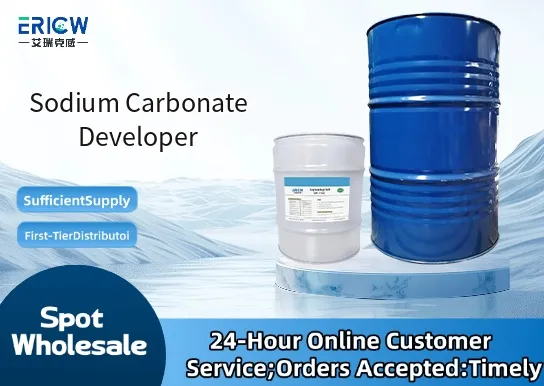
High-purity anhydrous sodium carbonate (Na₂CO₃) optimized for controlled alkalinity in developer formulations.
Consistent particle size distribution ensuring rapid, uniform dissolution in aqueous systems.
Low chloride and heavy metal impurities (<5 ppm Fe, <1 ppm Pb), critical for sensitive imaging and electroplating processes.
Non-hygroscopic under standard storage conditions, minimizing clumping and dosage variability.
REACH-compliant and non-RCRA hazardous when handled per SDS guidelines.
Alkaline activator in black-and-white photographic film and paper developers.
pH buffer and accelerator in electroless nickel plating baths.
Co-developer in high-speed thermal imaging systems (e.g., silver halide-based medical X-ray films).
Alkali source in textile dyeing auxiliaries for reactive dye fixation.
Stabilizer component in industrial cleaning concentrates for precision metal parts.
| Chemical Type | Anhydrous Sodium Carbonate (Na₂CO₃) |
| Product Form | Free-flowing white crystalline powder |
| Appearance | White, odorless, crystalline solid |
| Assay (Na₂CO₃, dry basis) | ≥ 99.5% w/w |
| Loss on Drying (105°C, 2 h) | ≤ 0.2% w/w |
| Chloride (Cl⁻) | ≤ 50 ppm |
| Iron (Fe) | ≤ 5 ppm |
| Heavy Metals (as Pb) | ≤ 1 ppm |
| Common Compatible Systems | Suitability |
| Kodak D-76–derived B&W developers | Highly Recommended – Provides optimal pH (10.8–11.2) and buffering capacity without precipitate formation |
| Electroless Nickel (EN) Plating Baths (e.g., Ni–P formulations) | Highly Recommended – Maintains bath stability and deposition rate; compatible with complexing agents (e.g., citrate, glycine) |
| Thermal dye diffusion transfer systems | Recommended – Effective alkali source for image-receiving layer activation; requires precise concentration control |
| Reactive dye fixing baths (cellulose substrates) | Suitable – Supports covalent bond formation; may require blending with sodium silicate for enhanced fixation |
Q1: What is the CAS Number for Sodium Carbonate Developer?
A: The CAS Number for anhydrous sodium carbonate is 497-19-8. This identifier applies to the high-purity grade used in developer applications.
Q2: What is the typical working concentration range in photographic developers?
A: Standard usage is 2–15 g/L, depending on formulation requirements; most B&W developers specify 8–12 g/L to achieve pH 11.0 ± 0.3 and sufficient buffering against acid byproducts.
Q3: How does Sodium Carbonate Developer differ from Sodium Hydroxide or Sodium Metaborate in developer systems?
A: Sodium carbonate offers milder alkalinity (pH ~11.5 in 1% solution) and superior buffering vs. NaOH (pH ~14), reducing fog and emulsion damage. Versus sodium metaborate, it delivers higher carbonate ion concentration for more robust pH maintenance during development.
Q4: Is this product compliant with EU REACH and FDA 21 CFR 176.170 for indirect food contact applications?
A: It is fully REACH registered and meets ACS Reagent Grade specifications. While not intended for direct food contact, its purity profile supports use in packaging-related cleaning or coating processes regulated under 21 CFR 176.170 when validated per application-specific migration testing.
Q5: Does Sodium Carbonate Developer exhibit extractable residues in high-purity water systems (e.g., semiconductor rinse stages)?
A: When used at recommended concentrations and followed by thorough DI water rinsing, residual carbonate ions are rapidly removed. Total dissolved solids (TDS) contribution is negligible (<0.5 µS/cm increase in ultrapure water at 10 ppm dosing), and no organic extractables are present.
Contact With Us:
E-mail: wangxingqiang@ericwchem.com
Have a Questions? Call Us:
Add:
Building A1, Jiete Industrial Park, Huangpu District, Guangzhou City, Guangdong Province, China