English
 Español
 tiếng việt
 русский
High thermal stability up to 250 °C continuous use temperature.
Excellent weather resistance and UV stability for long-term outdoor performance.
Good compatibility with organic resins and pigments for hybrid formulation flexibility.
Low surface energy enabling superior water repellency and anti-graffiti functionality.
Solvent-based liquid format with adjustable viscosity for easy integration into coating systems.
High-performance exterior architectural coatings for concrete and masonry.
Water-repellent impregnations for natural stone, brick, and façade elements.
Heat-resistant topcoats for industrial metal substrates and chimneys.
Anti-graffiti protective layers for public infrastructure and cultural heritage sites.
Hybrid silicone-acrylic binders in premium facade render systems.
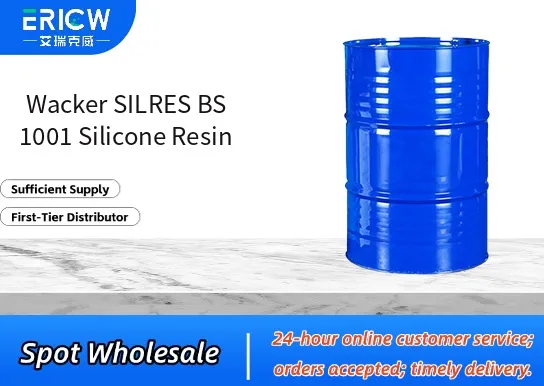
| Chemical Type | Methyl-phenyl silicone resin |
| Product Form | Liquid, solvent-based (xylene/toluene blend) |
| Appearance | Clear, colorless to pale yellow liquid |
| Non-Volatile Content | Approx. 50 wt.% |
| Viscosity (23 °C, DIN 53019) | 40–60 mPa·s |
| Density (23 °C) | 0.89–0.91 g/cm³ |
| Flash Point (PMCC) | Approx. 25 °C |
| Primary Applications | Protective coatings, impregnations, hybrid binder systems |
Q1: What is the primary function of SILRES BS 1001 in coating formulations?
A: SILRES BS 1001 acts as a reactive silicone resin modifier that enhances weather resistance, improves substrate wetting, and increases the durability and hydrophobic character of organic polymer-based coatings—especially in architectural and industrial topcoats.
Q2: Is SILRES BS 1001 compatible with waterborne systems?
A: Yes, SILRES BS 1001 is designed for use in both solvent-borne and waterborne systems. It can be incorporated into aqueous dispersions or emulsions, typically requiring mild mechanical stirring and sometimes pre-dilution to ensure uniform distribution.
Q3: How does SILRES BS 1001 differ from standard silicone oils or fluid antifoams?
A: Unlike non-reactive silicone fluids, SILRES BS 1001 contains hydrolyzable alkoxy groups that enable covalent bonding with inorganic substrates (e.g., mineral plasters, concrete) and crosslinking with other resin components—providing permanent, non-migrating performance benefits rather than temporary surface effects.
Q4: Can SILRES BS 1001 be used in high-solids or low-VOC formulations?
A: Yes, it is well-suited for high-solids and low-VOC systems due to its relatively low volatility and compatibility with modern binder technologies—including acrylics, polyurethanes, and silicate-based matrices—without compromising film formation or storage stability.
Contact With Us:
E-mail: wangxingqiang@ericwchem.com
Have a Questions? Call Us:
Add:
Building A1, Jiete Industrial Park, Huangpu District, Guangzhou City, Guangdong Province, China