English
 Español
 tiếng việt
 русский
Broad-spectrum efficacy against bacteria, fungi, and algae in industrial water systems.
Stable performance across a wide pH range (pH 4–9) and tolerant to common water treatment additives.
Low effective dosage requirement—typically 50–200 ppm for continuous control in recirculating cooling systems.
Compatible with oxidizing biocides for synergistic shock treatment programs.
Non-volatile and low-foaming formulation, minimizing operational disruption in high-turbulence systems.
Recirculating cooling water systems in power plants and HVAC installations.
Process water circuits in pulp & paper manufacturing facilities.
Oilfield produced water and injection water systems.
Industrial wastewater treatment basins and biofilm-prone piping networks.
Preservation of water-based metalworking fluids and emulsions.
| Chemical Type | Blend of 5-chloro-2-methyl-4-isothiazolin-3-one (CMIT) and 2-methyl-4-isothiazolin-3-one (MIT) |
| Product Form | Aqueous solution |
| Appearance | Clear, pale yellow liquid |
| Active Content (CMIT + MIT) | 1.4% w/w (nominal) |
| pH (1% aqueous solution) | 2.5–4.0 |
| Density (20°C) | 1.01–1.03 g/cm³ |
| Solubility | Completely miscible with water |
| Primary Applications | Non-oxidizing biocide for industrial water treatment |
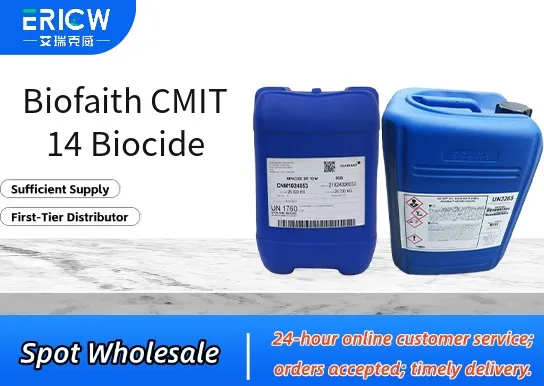
Q1: What is Biofaith CMIT 14 Biocide and what does the “14” signify?
A: Biofaith CMIT 14 Biocide is a broad-spectrum liquid biocide based on a controlled-release formulation of 5-chloro-2-methyl-4-isothiazolin-3-one (CMIT) and 2-methyl-4-isothiazolin-3-one (MIT), stabilized for enhanced compatibility and shelf life. The “14” refers to the nominal active ingredient concentration range—indicating it is formulated to deliver effective biocidal activity at typical use levels without requiring high dosing.
Q2: In which types of industrial formulations is Biofaith CMIT 14 commonly used?
A: It is widely applied in water-based industrial products such as metalworking fluids, latex paints, adhesives, coatings, construction chemicals, and cleaning concentrates—where sustained microbial control against bacteria, fungi, and yeasts is required during storage and in-use conditions.
Q3: How should Biofaith CMIT 14 be incorporated into a formulation?
A: It is typically added during the cool-down phase or at ambient temperature, after pH adjustment and under mild agitation. Due to its good water miscibility and stability across a broad pH range (approximately 2–10), it integrates easily without compromising formulation integrity—though compatibility testing with specific ingredients is always recommended.
Q4: Is Biofaith CMIT 14 compatible with other common preservatives or biocides?
A: Yes, it often exhibits synergistic effects when combined with complementary actives such as BIT or DCOIT, particularly for extended spectrum control. However, direct mixing with strong oxidizing agents or highly alkaline components may reduce efficacy, so sequential addition and compatibility verification are advised.
Q5: What safety and handling precautions should be observed?
A: As with all isothiazolinone-based biocides, appropriate personal protective equipment—including gloves, eye protection, and adequate ventilation—should be used during handling. Avoid skin contact and inhalation of mists or vapors. Refer to the current Safety Data Sheet for detailed toxicological information and first-aid measures.
Contact With Us:
E-mail: wangxingqiang@ericwchem.com
Have a Questions? Call Us:
Add:
Building A1, Jiete Industrial Park, Huangpu District, Guangzhou City, Guangdong Province, China