English
 Español
 tiếng việt
 русский
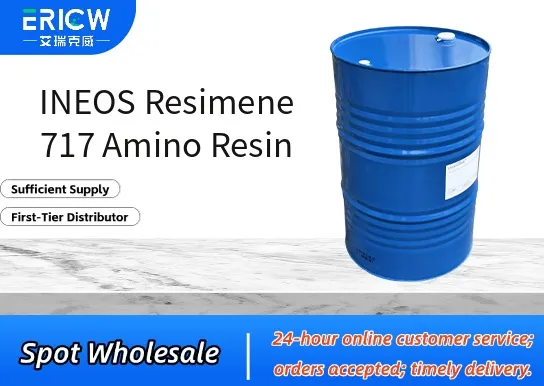
High reactivity with melamine-formaldehyde and urea-formaldehyde resins for rapid cure kinetics.
Excellent compatibility with acrylic, polyester, and alkyd binder systems in thermosetting coatings.
Low formaldehyde emission profile, supporting compliance with stringent VOC and emissions regulations.
Superior gloss retention and hardness development in baked coil and can coatings.
Consistent batch-to-batch performance due to tightly controlled polymerisation and purification processes.
Automotive OEM and refinish topcoats requiring high durability and mar resistance.
Industrial coil coatings for pre-painted metal used in building panels and appliances.
Food-can and beverage-can interior and exterior lacquers.
General-purpose industrial baking enamels for metal furniture and heating appliances.
High-performance powder coating crosslinkers for hybrid polyester-melamine systems.
| Chemical Type | Melamine-formaldehyde resin (partially alkylated) |
| Product Form | Liquid |
| Appearance | Clear, pale yellow to water-white liquid |
| Solvent Content | Approx. 60–65% (isobutanol/butanol blend) |
| Non-Volatile Content | 35–40% w/w at 125 °C for 60 minutes |
| pH (10% aqueous solution) | 7.5–8.5 |
| Viscosity (25 °C) | 15–25 mPa·s (Brookfield LV, spindle #1, 60 rpm) |
| Storage Stability | ≥12 months at 15–25 °C in sealed container |
Q1: What is the primary function of Resimene 717 in coating formulations?
A: Resimene 717 functions as a crosslinking agent, reacting with hydroxyl- or carboxyl-functional resins (e.g., acrylics, polyesters, alkyds) to form thermoset networks that enhance hardness, chemical resistance, and thermal stability in cured films.
Q2: Is Resimene 717 suitable for low-bake or ambient-cure systems?
A: Resimene 717 is formulated for conventional thermal curing, typically requiring bake temperatures above 120 °C. It is not designed for true ambient-cure applications; however, its reactivity profile allows compatibility with moderate-bake schedules when properly catalyzed.
Q3: How does Resimene 717 compare to melamine-formaldehyde resins with higher methylol content?
A: Resimene 717 offers a balanced combination of reactivity, storage stability, and film performance. Its lower free formaldehyde content and optimized methylolation level provide improved pot life in solventborne systems while maintaining efficient crosslinking efficiency under standard industrial baking conditions.
Q4: What solvents are recommended for diluting Resimene 717?
A: Resimene 717 is fully soluble in common organic solvents including aromatic hydrocarbons (e.g., xylene), ketones (e.g., MEK, acetone), and esters (e.g., butyl acetate). Compatibility with alcohols is limited; avoid prolonged exposure to water or strong protic solvents to maintain stability.
Q5: Can Resimene 717 be used in high-solids or low-VOC coating systems?
A: Yes — Resimene 717’s relatively low viscosity and high solids content make it well-suited for high-solids formulations. When combined with low-VOC resins and appropriate solvent blends, it supports compliance strategies targeting reduced emissions without compromising cure response or final film properties.
Contact With Us:
E-mail: wangxingqiang@ericwchem.com
Have a Questions? Call Us:
Add:
Building A1, Jiete Industrial Park, Huangpu District, Guangzhou City, Guangdong Province, China