English
 Español
 tiếng việt
 русский
High-gloss, smooth film formation with excellent flow and leveling characteristics.
Outstanding weather resistance and UV stability for long-term outdoor performance.
Excellent compatibility with TGIC-free curing agents, supporting sustainable powder coating formulations.
Good mechanical properties including impact resistance and flexibility on metal substrates.
Consistent batch-to-batch reproducibility and optimized melt viscosity for reliable extrusion and grinding.
Architectural aluminum extrusions (e.g., window frames, curtain walls).
Outdoor furniture and garden equipment coatings.
Agricultural and construction machinery components.
Automotive non-under-hood exterior trim parts.
General industrial metal enclosures and housings requiring durable finish.
| Chemical Type | Carboxyl-functional saturated polyester |
| Product Form | Free-flowing granules |
| Appearance | Off-white to light beige granules |
| Acid Value (mg KOH/g) | 27–33 |
| Number Average Molecular Weight (Mn) | ~2,800–3,200 |
| Softening Point (°C, Ring & Ball) | 78–84 |
| Primary Applications | TGIC-free and TGIC-containing polyester powder coatings |
| Key Features | Weather durability, high gloss, good transfer efficiency |
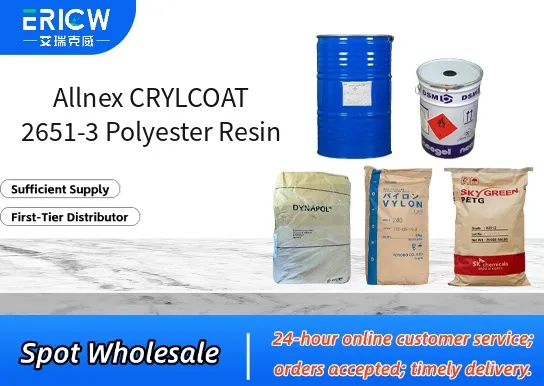
Q1: What is the primary application of CRYLCOAT 2651-3 in powder coating formulations?
A: CRYLCOAT 2651-3 is a carboxyl-functional polyester resin specifically designed for use in TGIC-free, high-gloss, weather-resistant thermosetting powder coatings—particularly suited for outdoor architectural and industrial metal finishing applications.
Q2: Which curing agents is CRYLCOAT 2651-3 compatible with?
A: This resin is formulated for use with standard epoxy-functional hardeners such as glycidyl ester or triglycidyl isocyanurate (TGIC alternatives), enabling robust crosslinking without TGIC. Compatibility should always be verified through small-scale formulation trials.
Q3: How does CRYLCOAT 2651-3 contribute to film performance in exterior applications?
A: It delivers excellent UV resistance, gloss retention, and chalking resistance due to its optimized aromatic-aliphatic backbone structure, supporting long-term durability in demanding outdoor exposure conditions.
Q4: Is CRYLCOAT 2651-3 suitable for low-cure or energy-efficient powder coating processes?
A: While primarily optimized for conventional cure schedules (e.g., 180–200 °C for 10–15 minutes), it can be adapted to lower-temperature curing systems when paired with reactive co-resins or catalysts—formulation adjustments and performance validation are recommended.
Contact With Us:
E-mail: wangxingqiang@ericwchem.com
Have a Questions? Call Us:
Add:
Building A1, Jiete Industrial Park, Huangpu District, Guangzhou City, Guangdong Province, China