English
 Español
 tiếng việt
 русский
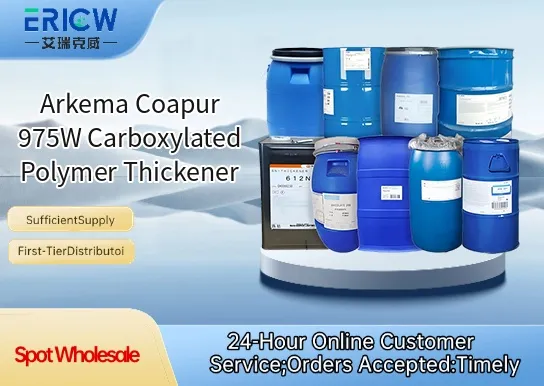
High-efficiency rheology modifier delivering strong pseudoplastic behavior and excellent viscosity build in aqueous systems.
Carboxylated polymer structure ensures robust performance across a broad pH range (pH 4–10) without requiring neutralization.
Provides outstanding shear-thinning properties, enabling easy application and leveling while maintaining sag resistance.
Compatible with common surfactants, co-thickeners, and biocides used in industrial and architectural formulations.
Low VOC and APEO-free, supporting compliance with stringent environmental and regulatory standards.
Architectural waterborne paints (interior and exterior flat, satin, and semi-gloss formulations).
Industrial maintenance coatings including primers, topcoats, and anti-corrosive systems.
Water-based adhesives and construction sealants requiring controlled flow and open time.
Textile printing pastes where stable viscosity and pigment dispersion are critical.
Tile grouts and cementitious repair mortars for improved workability and water retention.
| Chemical Type | Acrylic carboxylated polymer |
| Product Form | Aqueous dispersion (non-ionic) |
| Appearance | Opaque white liquid |
| pH (as supplied) | 3.0 – 4.5 |
| Solids Content | 28.0 – 30.0 wt% |
| Viscosity (Brookfield RVT, spindle #3, 20 rpm, 25°C) | 1,500 – 3,500 mPa·s |
| Density (25°C) | 1.02 – 1.05 g/cm³ |
| Freeze-Thaw Stability | Pass (3 cycles at –15°C / 23°C) |
Q1: What is the primary function of Coapur 975W in water-based formulations?
A: Coapur 975W is a carboxylated acrylic polymer designed to provide efficient rheology modification and viscosity build in aqueous systems, particularly offering excellent shear-thinning behavior and good sag resistance without compromising flow or leveling.
Q2: Is Coapur 975W compatible with common biocides and surfactants used in architectural coatings?
A: Yes, Coapur 975W demonstrates broad compatibility with typical non-ionic and anionic surfactants, as well as commonly used isothiazolinone- and benzisothiazole-based biocides. Compatibility should still be verified under specific formulation conditions, especially at high pH or in the presence of strong electrolytes.
Q3: How does Coapur 975W perform under freeze-thaw cycling?
A: Coapur 975W exhibits good freeze-thaw stability when properly incorporated into stable emulsion systems. Its performance depends on overall formulation robustness—including polymer type, co-thickeners, and protective colloid content—so full system validation is recommended for critical applications.
Q4: Can Coapur 975W be used in low-VOC or zero-VOC formulations?
A: Yes, Coapur 975W is supplied as a water-based dispersion with negligible VOC content and is widely employed in low- and zero-VOC architectural and industrial coatings where regulatory compliance and environmental performance are priorities.
Contact With Us:
E-mail: wangxingqiang@ericwchem.com
Have a Questions? Call Us:
Add:
Building A1, Jiete Industrial Park, Huangpu District, Guangzhou City, Guangdong Province, China