English
 Español
 tiếng việt
 русский
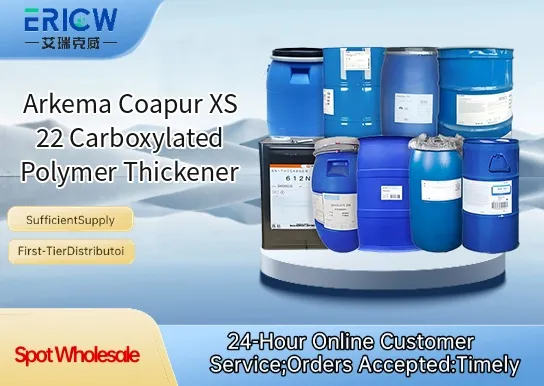
High-efficiency rheology modifier delivering excellent viscosity build and shear-thinning behavior in waterborne systems.
Carboxylated polymer architecture ensures robust thickening performance across a broad pH range (pH 6–10).
Low foaming profile, minimizing air entrapment and enabling improved film formation in coatings and inks.
Enhanced compatibility with common surfactants, co-thickeners, and functional additives in industrial formulations.
Stable performance under freeze-thaw cycling, supporting reliable shelf life and field application consistency.
Architectural interior and exterior latex paints.
Industrial maintenance coatings for metal and concrete substrates.
Water-based wood stains and clear finishes.
Printing inks for flexographic and gravure processes.
Construction adhesives and tile grouts requiring controlled sag resistance.
| Chemical Type | Acrylic carboxylated polymer |
| Product Form | Aqueous dispersion |
| Appearance | Opaque white liquid |
| pH (as supplied) | 7.0–8.5 |
| Solids Content | 22 ± 1 wt% |
| Viscosity (Brookfield, RVT, Spindle #3, 20 rpm, 25°C) | 1,500–4,000 cP |
| Primary Applications | Waterborne architectural coatings, industrial coatings, inks, construction chemicals |
| Key Features | Rheology control, low foam, pH stability, freeze-thaw resistance |
Q1: What is the primary mechanism of thickening for Coapur XS 22?
A: Coapur XS 22 functions as a water-soluble, anionic associative thickener. Its carboxylated polymer structure enables pH-responsive viscosity development through partial neutralization and intermolecular association, particularly in aqueous systems containing surfactants or co-solvents.
Q2: How should Coapur XS 22 be incorporated into a formulation?
A: It is typically added post-emulsification or during the final aqueous phase blending stage. Pre-dissolution in deionized water at neutral to slightly alkaline pH (e.g., using ammonia or sodium hydroxide) is recommended to ensure complete dispersion and avoid gel lumps. High-shear mixing aids uniform incorporation.
Q3: Is Coapur XS 22 compatible with common preservatives and biocides used in water-based coatings and personal care products?
A: Yes, it demonstrates good compatibility with widely used isothiazolinone- and formaldehyde-releasing preservatives under typical usage conditions. However, compatibility should be verified empirically in the final formulation due to potential interactions with cationic actives or high levels of multivalent ions.
Q4: Does Coapur XS 22 offer rheological benefits beyond viscosity increase?
A: Yes — it imparts pronounced shear-thinning behavior and enhances sag resistance in vertical applications, while maintaining good flow and leveling upon application. Its associative nature also contributes to improved film integrity and reduced water sensitivity in dried films.
Q5: What are key storage and handling considerations for Coapur XS 22?
A: Store in original sealed containers at temperatures between 5 °C and 30 °C, away from direct sunlight and freezing conditions. Avoid prolonged exposure to strongly acidic environments (pH < 4) or high concentrations of calcium/magnesium ions, which may reduce performance stability over time.
Contact With Us:
E-mail: wangxingqiang@ericwchem.com
Have a Questions? Call Us:
Add:
Building A1, Jiete Industrial Park, Huangpu District, Guangzhou City, Guangdong Province, China