English
 Español
 tiếng việt
 русский
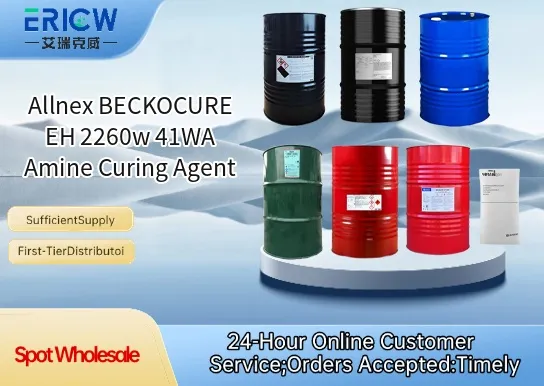
Low-viscosity liquid amine curing agent enabling excellent processability and easy metering in automated systems.
Fast-reacting aliphatic amine formulation delivering rapid gel time and early handling strength at ambient temperature.
Designed for high-performance epoxy systems requiring low VOC, non-yellowing cure and superior chemical resistance.
Compatible with standard bisphenol-A and bisphenol-F epoxy resins without requiring solvent dilution.
Offers balanced pot life and cure speed—ideal for industrial coatings, adhesives, and composite applications.
Industrial maintenance and protective coatings for steel and concrete substrates.
High-solids and solvent-free epoxy flooring systems.
Structural adhesives for automotive and aerospace bonding.
Potting and encapsulation compounds for electrical and electronic components.
Wind turbine blade composite matrices and repair formulations.
| Chemical Type | Aliphatic polyamine adduct |
| Product Form | Liquid |
| Appearance | Clear to pale yellow, homogeneous liquid |
| Primary Applications | Epoxy coatings, adhesives, composites, and encapsulants |
| Key Features | Ambient-cure capability, low volatility, non-yellowing performance |
| Benefits | Reduced energy consumption, improved workplace safety, enhanced durability |
| Storage Stability | Stable under dry, cool conditions (≤25°C) for ≥12 months in unopened containers |
| Handling Precautions | Use appropriate PPE; avoid skin contact and inhalation of mists |
Q1: What is the primary function of BECKOCURE EH 2260w 41WA in epoxy systems?
A: BECKOCURE EH 2260w 41WA is a water-dispersible aliphatic amine curing agent designed to enable ambient- or low-temperature cure of epoxy resins, offering good pot life control and reduced volatility compared to traditional solvent-based amines.
Q2: Is BECKOCURE EH 2260w 41WA compatible with standard bisphenol A and bisphenol F epoxy resins?
A: Yes, it demonstrates broad compatibility with common liquid and solid epoxy resins, including diglycidyl ether of bisphenol A (DGEBA) and bisphenol F types, and is particularly suited for waterborne and high-solids epoxy formulations.
Q3: How does the water dispersion characteristic affect formulation handling and storage?
A: As a stable aqueous dispersion, it simplifies handling by eliminating the need for organic solvents, reduces VOC content, and supports safer workplace practices — though formulations should be protected from freezing and excessive shear during mixing to maintain dispersion integrity.
Q4: What type of performance can be expected in cured films, especially regarding chemical resistance and flexibility?
A: Cured systems typically deliver balanced mechanical properties, including good flexibility, impact resistance, and moderate resistance to alkalis and mild acids — performance is optimized when fully cured and may vary depending on resin selection, film thickness, and ambient conditions.
Contact With Us:
E-mail: wangxingqiang@ericwchem.com
Have a Questions? Call Us:
Add:
Building A1, Jiete Industrial Park, Huangpu District, Guangzhou City, Guangdong Province, China