English
 Español
 tiếng việt
 русский
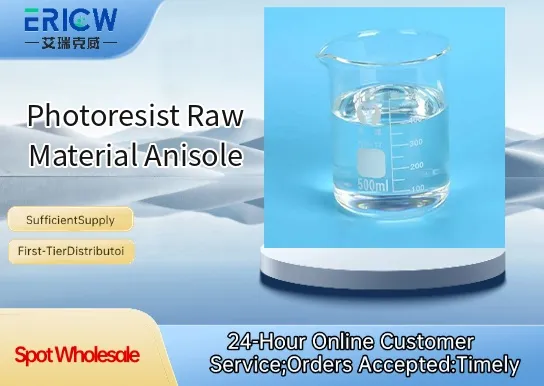
High-purity aromatic solvent optimized for photoresist formulation with minimal trace metals and moisture content.
Excellent solvency for novolac resins, diazonaphthoquinone (DNQ) inhibitors, and other photoacid generator (PAG) components.
Low volatility profile enables stable coating viscosity and reduced solvent popping during spin-coating.
Controlled boiling point (154–155 °C) supports precise thermal ramping in pre-bake and post-exposure bake (PEB) processes.
Consistent batch-to-batch performance validated via GC-FID and Karl Fischer titration.
Primary solvent in g-line and i-line positive-tone photoresists for semiconductor front-end manufacturing.
Co-solvent in advanced chemically amplified resists (CARs) for 248 nm lithography.
Processing aid in photomask resist formulations requiring high-resolution pattern fidelity.
Carrier medium for photosensitive polyimide precursors used in flexible display and MEMS packaging.
Stabilizing agent in photoresist reclaim and recycling systems to preserve resin integrity.
| Chemical Type | Aromatic ether (methoxybenzene) |
| Product Form | Clear, colorless liquid |
| Appearance | Transparent, free of suspended particles or haze |
| Melting Point | −37 °C |
| Boiling Point | 154–155 °C at 760 mmHg |
| Purity (GC) | ≥99.95% (main peak) |
| Water Content (KF) | ≤50 ppm |
| Residue on Evaporation | ≤10 ppm |
| Common Compatible Systems | Suitability |
| Novolac/DNQ-based i-line resists (e.g., TOK TMMR series) | Highly Recommended – Proven compatibility with resin dissolution kinetics and film uniformity |
| 248 nm CAR systems using PAGs (e.g., triarylsulfonium salts) | Recommended – Requires controlled blending ratio to maintain acid diffusion control |
| Photomask resist platforms (e.g., JSR MPR series) | Highly Recommended – Supports high optical density and low defect generation |
| Photoresist filtration and recirculation units (e.g., Entegris CPF systems) | Suitable – Chemically inert toward fluoropolymer membranes and stainless-steel wetted parts |
Q1: What is the CAS Number for anisole used in photoresist applications?
A: The CAS Registry Number for high-purity anisole is 100-66-3. Our photoresist-grade material conforms to this identifier with full analytical traceability per batch.
Q2: What is the typical recommended usage concentration in photoresist formulations?
A: Anisole is commonly used at 70–85 wt% in solvent blends, often combined with propylene glycol monomethyl ether acetate (PGMEA) to fine-tune evaporation rate and film formation.
Q3: How does anisole compare to ethyl lactate or PGMEA in terms of residue and outgassing?
A: Anisole exhibits lower thermal decomposition onset (>220 °C) and negligible non-volatile residue versus ethyl lactate; unlike PGMEA, it shows no ester hydrolysis risk under ambient storage, minimizing acid-catalyzed degradation pathways.
Q4: Is photoresist-grade anisole compliant with SEMI S2/S8 and REACH regulations?
A: Yes — our material meets SEMI C12 purity standards and carries full REACH SVHC declaration; SDS and regulatory dossiers are available upon request for qualified customers.
Q5: Does anisole migrate or extract into underlying dielectric layers during processing?
A: No significant migration is observed under standard lithography conditions (pre-bake ≤120 °C, exposure dose ≤1000 mJ/cm²); residual solvent is fully removed during post-apply bake, as confirmed by FTIR and SIMS depth profiling.
Contact With Us:
E-mail: wangxingqiang@ericwchem.com
Have a Questions? Call Us:
Add:
Building A1, Jiete Industrial Park, Huangpu District, Guangzhou City, Guangdong Province, China