English
 Español
 tiếng việt
 русский
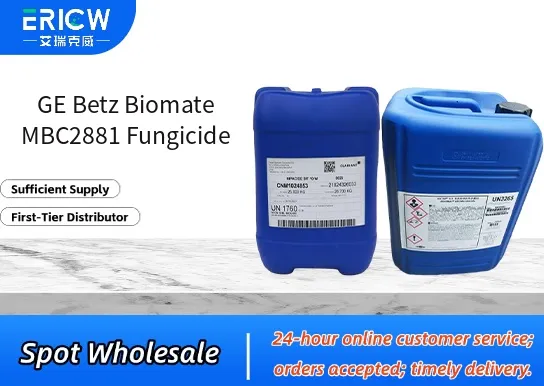
Broad-spectrum fungicidal activity against common slime-forming fungi and yeasts in industrial water systems.
Non-oxidizing biocide formulation compatible with common corrosion inhibitors and scale control agents.
Effective at low dosage levels, supporting sustainable water treatment programs and reduced chemical handling.
pH-stable performance across typical cooling water operating ranges (pH 6.0–9.0).
Low volatility and minimal odor, enhancing workplace safety and operator acceptance.
Cooling water systems in power generation facilities.
Recirculating water circuits in HVAC and commercial building cooling towers.
Process water systems in pulp and paper manufacturing.
Industrial closed-loop chilled water systems requiring biofouling control.
Supplemental microbiological control in combined oxidant/non-oxidant treatment programs.
| Chemical Type | Organic heterocyclic biocide (isothiazolinone-based) |
| Product Form | Aqueous liquid concentrate |
| Appearance | Clear, light amber liquid |
| Primary Applications | Microbiological control in industrial recirculating water systems |
| Key Features | Non-oxidizing, broad-spectrum, pH-stable, low-foaming |
| Benefits | Reduces slime buildup, maintains heat transfer efficiency, extends system component life |
| Storage Stability | Stable for ≥12 months at 5–30°C when stored in original sealed container |
| Handling Classification | Designed for industrial use; refer to SDS for safe handling guidance |
Q1: What is the primary mode of action of Biomate MBC2881?
A: Biomate MBC2881 functions as a broad-spectrum fungistatic agent, primarily inhibiting fungal growth through interference with cellular metabolism and membrane integrity. Its activity is optimized in recirculating water systems where sustained microbial control is required.
Q2: In which types of industrial water systems is MBC2881 typically applied?
A: It is commonly used in closed-loop cooling water systems, chilled water systems, and process water circuits—especially where biofilm formation and fungal proliferation pose operational or corrosion-related risks. Compatibility with common scale and corrosion inhibitors supports its integration into comprehensive water treatment programs.
Q3: How should MBC2881 be dosed for effective fungal control?
A: Dosage is system-specific and depends on water quality, temperature, organic loading, and microbial challenge. It is typically introduced continuously or intermittently at low concentrations, with initial shock doses sometimes recommended during commissioning or after biocide upsets. Field trials and microbiological monitoring are advised to establish optimal application rates.
Q4: Is Biomate MBC2881 compatible with common oxidizing biocides?
A: MBC2881 is generally non-reactive with chlorine dioxide and stabilized bromine-based oxidants under typical operating conditions. However, direct mixing with strong oxidizers like free chlorine or ozone is not recommended without prior compatibility testing, as oxidative degradation may reduce efficacy.
Q5: What safety and handling precautions should be observed?
A: As with all industrial biocides, appropriate personal protective equipment—including chemical-resistant gloves, goggles, and respiratory protection when handling concentrated product—is essential. Refer to the Safety Data Sheet (SDS) for detailed hazard information, first-aid measures, and disposal guidance. Storage should be in a cool, dry, well-ventilated area away from incompatible materials.
Contact With Us:
E-mail: wangxingqiang@ericwchem.com
Have a Questions? Call Us:
Add:
Building A1, Jiete Industrial Park, Huangpu District, Guangzhou City, Guangdong Province, China