English
 Español
 tiếng việt
 русский
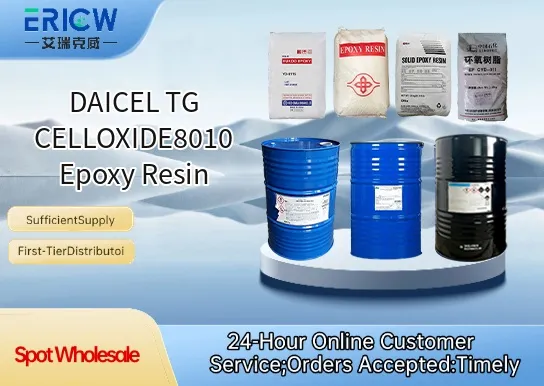
Highly reactive cycloaliphatic epoxy resin with low viscosity for excellent processability.
Outstanding UV stability and weather resistance due to saturated ring structure.
Low chlorine content (< 100 ppm), supporting high-purity applications including electronics and optical coatings.
Excellent electrical insulation properties and thermal stability up to 180 °C.
Compatible with a wide range of anhydride, amine, and photoinitiator curing systems.
UV-curable coatings for optical lenses and precision optics.
High-performance encapsulants and potting compounds for LED and semiconductor packaging.
Electrical insulating varnishes for motors, transformers, and coil winding.
Advanced composites requiring low shrinkage and high glass transition temperature (Tg).
Adhesives for aerospace and automotive structural bonding where UV resistance is critical.
| Chemical Type | Cycloaliphatic diglycidyl ether |
| Product Form | Liquid |
| Appearance | Colorless to pale yellow transparent liquid |
| Epoxy Equivalent Weight (EEW) | 135–145 g/eq |
| Viscosity (25 °C) | 300–500 mPa·s |
| Chlorine Content | ≤ 100 ppm |
| Glass Transition Temperature (Tg) – cured | ≥ 170 °C (with methylhexahydrophthalic anhydride) |
| Primary Applications | UV-curable coatings, electronic encapsulation, electrical insulation |
Q1: What is the primary chemical nature of CELLOXIDE 8010?
A: CELLOXIDE 8010 is a cycloaliphatic epoxy resin based on a diglycidyl ether structure, featuring high functionality and low viscosity. It contains no aromatic rings, contributing to its excellent UV stability, low color development, and reduced tendency for yellowing upon aging or exposure.
Q2: How does CELLOXIDE 8010 differ from conventional bisphenol-A epoxy resins in terms of reactivity and curing behavior?
A: Unlike standard bisphenol-A epoxies, CELLOXIDE 8010 exhibits higher thermal stability and requires cationic or latent catalysts (e.g., photoacid generators or thermally activated initiators) for efficient polymerization. Its cycloaliphatic backbone enables rapid cure under UV or thermal conditions with minimal shrinkage and excellent hardness development.
Q3: Is CELLOXIDE 8010 suitable for UV-curable coatings and inks?
A: Yes — it is widely used in high-performance UV-curable formulations such as protective coatings, overprint varnishes, and electronic encapsulants due to its fast photoreactivity, low volatility, and ability to yield films with high gloss, chemical resistance, and dimensional stability.
Q4: Can CELLOXIDE 8010 be blended with other epoxy resins or monomers?
A: Yes — it is compatible with many epoxy-functional monomers, oligomers, and other cycloaliphatic epoxies. Blending allows formulators to tailor viscosity, reactivity, flexibility, and final film properties while maintaining good shelf stability when properly inhibited.
Q5: What are key handling and storage considerations for CELLOXIDE 8010?
A: Store in tightly sealed containers under dry, cool conditions away from moisture, strong acids, and direct sunlight. Prolonged exposure to ambient humidity or acidic contaminants may lead to premature ring-opening or viscosity increase. Recommended handling includes use of dry nitrogen blanketing for long-term storage.
Contact With Us:
E-mail: wangxingqiang@ericwchem.com
Have a Questions? Call Us:
Add:
Building A1, Jiete Industrial Park, Huangpu District, Guangzhou City, Guangdong Province, China