English
 Español
 tiếng việt
 русский
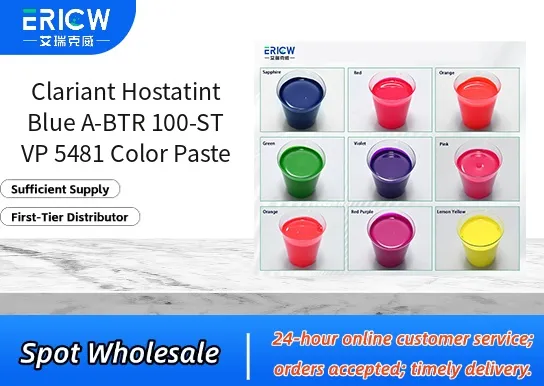
High chroma, brilliant blue shade with excellent batch-to-batch color consistency.
Optimized for high-shear dispersion in water-based systems, ensuring rapid wetting and uniform distribution.
Excellent lightfastness and thermal stability up to 160 °C for demanding processing conditions.
Low volatile organic compound (VOC) content, supporting sustainable formulation requirements.
Compatible with anionic and non-ionic surfactants, enabling broad formulation flexibility in aqueous media.
Architectural coatings including interior and exterior wall paints.
Industrial maintenance coatings for metal and concrete substrates.
Water-based wood stains and clear finishes.
Printing inks for packaging applications requiring high color strength and clarity.
Specialty textile printing pastes for natural and blended fibers.
| Chemical Type | Organic pigment dispersion (C.I. Pigment Blue 15:3) |
| Product Form | Aqueous color paste, liquid |
| Appearance | Viscous, homogeneous blue paste |
| Primary Applications | Water-based architectural and industrial coatings, inks, and wood finishes |
| Key Features | High tinctorial strength, excellent dispersibility, low VOC |
| Benefits | Reduced grinding time, improved color development, consistent performance across batches |
| pH (10% aqueous dilution) | 7.5 – 8.5 |
| Storage Stability | ≥ 12 months at 5–30 °C in sealed original container |
Q1: What is the primary application field for Hostatint Blue A-BTR 100-ST VP 5481?
A: This pigment paste is specifically developed for coloring polyolefin-based compounds, including PP and PE, in applications such as injection molding, blow molding, and extrusion—particularly where high thermal stability and good dispersion are required.
Q2: Is this color paste suitable for food-contact applications?
A: Hostatint Blue A-BTR 100-ST VP 5481 is formulated to meet general regulatory expectations for indirect food contact in polyolefins, subject to final compliance verification by the compounder or end user based on applicable regional requirements and processing conditions.
Q3: How should this paste be incorporated into polymer melts?
A: It is typically introduced via gravimetric or volumetric dosing directly into the extruder feed throat or hopper, or pre-compounded into masterbatches. Good melt mixing and sufficient residence time ensure optimal dispersion and color uniformity.
Q4: What are the key handling and storage recommendations?
A: Store in original sealed containers at temperatures between 5 °C and 30 °C, away from direct sunlight and sources of heat. Avoid freezing, and ensure containers remain tightly closed when not in use to prevent moisture uptake or skin formation.
Contact With Us:
E-mail: wangxingqiang@ericwchem.com
Have a Questions? Call Us:
Add:
Building A1, Jiete Industrial Park, Huangpu District, Guangzhou City, Guangdong Province, China