English
 Español
 tiếng việt
 русский
Excellent abrasion resistance for extended service life in dynamic applications.
Outstanding low-temperature flexibility down to –30 °C without cracking.
Good oil and grease resistance suitable for industrial and automotive environments.
High transparency and clarity retention after prolonged UV exposure.
Easy processing via extrusion, injection molding, and calendering with minimal thermal degradation.
Automotive interior trim components including instrument panel skins and door inserts.
Medical tubing and fluid-contact devices requiring biocompatibility and kink resistance.
High-clarity protective films for electronic displays and touchscreens.
Flexible hoses and pneumatic connectors in industrial automation systems.
Wear-resistant shoe soles and sports equipment components.
| Chemical Type | Aliphatic polyester-based thermoplastic polyurethane |
| Product Form | Pellets (free-flowing, cylindrical) |
| Appearance | Transparent, slightly yellowish granules |
| Primary Applications | Extruded films, molded parts, co-extruded profiles |
| Key Features | UV-stable, non-yellowing, hydrolysis-resistant |
| Processing Temperature Range | 180–220 °C (melt processing) |
| Density (ASTM D792) | 1.18–1.20 g/cm³ |
| Shore A Hardness (ASTM D2240) | 85–88 |
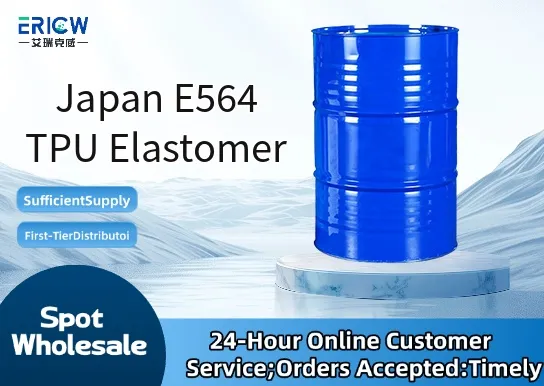
Q1: What is the primary functional role of Japan E564 TPU Elastomer in polymer formulations?
A: Japan E564 TPU Elastomer is primarily used as a high-performance thermoplastic polyurethane modifier to enhance elasticity, abrasion resistance, and low-temperature flexibility in engineering plastics and elastomeric blends.
Q2: Is Japan E564 compatible with common thermoplastics such as ABS, PC, or PP?
A: Yes — Japan E564 demonstrates good compatibility with ABS and polycarbonate, often used in impact-modified blends; compatibility with polypropylene typically requires compatibilizers or reactive processing to achieve stable morphology.
Q3: What processing methods are recommended for Japan E564 TPU Elastomer?
A: It is well-suited for standard thermoplastic processing techniques including injection molding, extrusion, and twin-screw compounding. Drying prior to processing is recommended to maintain optimal melt stability and mechanical performance.
Q4: Does Japan E564 TPU Elastomer meet food-contact or medical-grade compliance requirements?
A: Japan E564 is not pre-certified for direct food-contact or medical applications; suitability for regulated end uses depends on final formulation, processing conditions, and third-party validation per applicable regional requirements.
Contact With Us:
E-mail: wangxingqiang@ericwchem.com
Have a Questions? Call Us:
Add:
Building A1, Jiete Industrial Park, Huangpu District, Guangzhou City, Guangdong Province, China