English
 Español
 tiếng việt
 русский
High chroma and excellent color strength for vibrant, consistent hue reproduction.
Outstanding thermal stability up to 280 °C, enabling compatibility with high-temperature processing.
Good lightfastness (ISO 105-B02, Grade 7–8) and weather resistance in demanding outdoor applications.
Low volatility and minimal extractables, supporting compliance with stringent regulatory requirements.
Excellent dispersibility in both polar and non-polar polymer matrices, including polyolefins and engineering plastics.
Coloration of polypropylene (PP) and polyethylene (PE) for automotive interior components.
Pigmentation of masterbatches used in packaging films and rigid containers.
High-performance coloring of engineering plastics such as ABS and PC/ABS blends.
Specialty applications in wire & cable sheathing requiring long-term UV and heat resistance.
Food-contact-compliant plastic articles where migration control and regulatory acceptance are critical.
| Chemical Type | Benzimidazolone derivative |
| Product Form | Free-flowing powder |
| Appearance | Reddish-orange powder |
| Primary Applications | Polyolefins, engineering plastics, masterbatches |
| Key Features | Thermal stability, dispersion efficiency, lightfastness |
| Benefits | Consistent batch-to-batch color, low dust generation, regulatory support (EU, FDA, China GB) |
| Particle Size (D50) | 0.15–0.25 µm (by laser diffraction) |
| Volatile Content | < 0.5 wt% (at 105 °C, 2 h) |
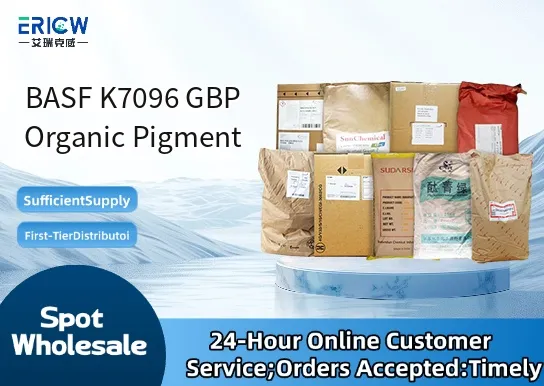
Q1: What is the primary application field for BASF K7096 GBP?
A: BASF K7096 GBP is a high-performance organic pigment specifically developed for demanding plastic coloration applications, particularly in polyolefins (e.g., PP and PE) where excellent heat stability, dispersion behavior, and lightfastness are required.
Q2: Is K7096 GBP suitable for food-contact plastics?
A: K7096 GBP is designed to meet stringent regulatory expectations for plastic colorants. While it is not inherently certified for all food-contact applications, it may be used in compliant formulations where the final article meets applicable regional requirements—formulators must validate compliance through full system testing and regulatory review.
Q3: How does K7096 GBP perform under high-temperature processing conditions?
A: K7096 GBP exhibits very good thermal stability, enabling reliable performance during standard polyolefin processing such as injection molding and extrusion without significant hue shift or degradation, provided recommended temperature limits are observed.
Q4: What is the typical dosage range when using K7096 GBP in polypropylene?
A: Dosage depends on the desired shade intensity and specific formulation requirements, but K7096 GBP is typically used at low concentrations—generally ranging from 0.1% to 2% by weight—in polypropylene systems due to its high tinctorial strength and efficient dispersion.
Contact With Us:
E-mail: wangxingqiang@ericwchem.com
Have a Questions? Call Us:
Add:
Building A1, Jiete Industrial Park, Huangpu District, Guangzhou City, Guangdong Province, China