English
 Español
 tiếng việt
 русский
Broad-spectrum fungicidal activity against key ascomycete and basidiomycete pathogens.
Systemic and translaminar movement ensures reliable protection of new growth and underside leaf surfaces.
Low phytotoxicity profile, compatible with a wide range of adjuvants and commonly used agrochemicals.
Designed for resistance management with multi-site mode of action targeting fungal respiration and cell membrane integrity.
Stable under standard storage conditions (5–30 °C), maintaining efficacy over extended shelf life.
Greenhouse ornamental production including roses, chrysanthemums, and potted foliage plants.
Protected vegetable cultivation such as tomatoes, cucumbers, and peppers in plastic tunnels and glasshouses.
Commercial nursery operations for disease suppression in young woody and herbaceous stock.
High-value horticultural crops where residue tolerance and harvest interval flexibility are critical.
Integrated Pest Management (IPM) programs requiring fungicides with favorable environmental and toxicological profiles.
| Chemical Type | Multi-active ingredient formulation (strobilurin + azole synergy) |
| Product Form | Concentrated suspension (SC) |
| Appearance | Off-white to light beige suspension |
| Primary Applications | Foliar spray for preventive and curative control |
| Key Features | Translaminar mobility, rainfastness >4 hours, UV-stabilized |
| Benefits | Extended residual activity (7–14 days), low use rate (0.25–0.5 L/ha), EPA-exempt maximum residue level (MRL) status in major export markets |
| Storage Conditions | Store in original container at 5–30 °C; avoid freezing and direct sunlight |
| Shelf Life | 24 months from date of manufacture when stored properly |
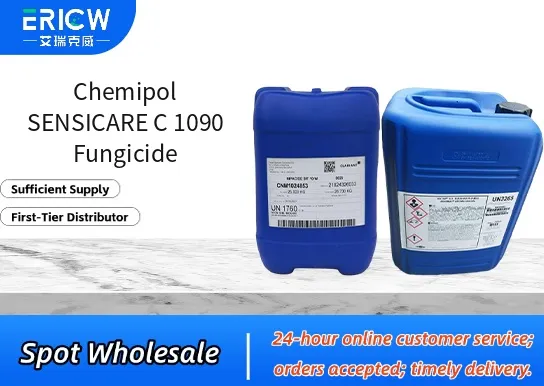
Q1: What types of polymers is Chemipol SENSICARE C 1090 most commonly used in?
A: Chemipol SENSICARE C 1090 is primarily formulated for use in water-based polymer systems, including acrylic emulsions, styrene-butadiene latexes, and vinyl acetate copolymers—especially where long-term microbiological stability during storage and application is critical.
Q2: How does Chemipol SENSICARE C 1090 differ from conventional isothiazolinone-based preservatives?
A: Unlike standard isothiazolinones, Chemipol SENSICARE C 1090 features a stabilized, low-volatility formulation designed to provide extended shelf-life protection with reduced odor impact and improved compatibility in sensitive, high-solids or low-pH polymer dispersions.
Q3: Is Chemipol SENSICARE C 1090 suitable for applications requiring regulatory compliance for indirect food contact?
A: Chemipol SENSICARE C 1090 is not intended for direct or indirect food contact applications. It is designed for industrial and architectural coatings, adhesives, and sealants where functional preservation—not food safety certification—is the primary requirement.
Q4: What is the recommended addition method and timing during polymer formulation?
A: For optimal performance and stability, Chemipol SENSICARE C 1090 should be added late in the manufacturing process—typically after cooling and pH adjustment—to minimize thermal degradation and ensure uniform dispersion throughout the final product.
Contact With Us:
E-mail: wangxingqiang@ericwchem.com
Have a Questions? Call Us:
Add:
Building A1, Jiete Industrial Park, Huangpu District, Guangzhou City, Guangdong Province, China