English
 Español
 tiếng việt
 русский
High reactivity with hydroxyl-terminated polyols, enabling rapid gelation and short demold times.
Excellent compatibility with aromatic polyester and polyether polyols for uniform dispersion.
Low viscosity at room temperature, facilitating easy metering, mixing, and processing in automated systems.
Consistent batch-to-batch performance ensured by strict TDI-based synthesis control and purification.
Optimized functionality balance for enhanced mechanical properties in cured elastomers and coatings.
Cast polyurethane elastomer (CPU) systems for industrial rollers, wear plates, and mining screens.
Reaction injection molding (RIM) and structural RIM (SRIM) components in automotive and agricultural equipment.
High-performance polyurethane coatings for concrete flooring, tank linings, and corrosion-resistant surfaces.
Flexible and semi-rigid polyurethane foam formulations requiring fast cure kinetics and dimensional stability.
Adhesives and sealants where rapid green strength development and thermal resistance are critical.
| Chemical Type | Aromatic polyisocyanate blend based on toluene diisocyanate (TDI) |
| Product Form | Liquid |
| Appearance | Clear to pale yellow transparent liquid |
| NCO Content (wt%) | 12.8–13.2% |
| Viscosity at 25°C (mPa·s) | 180–220 |
| Specific Gravity (25°C) | 1.18–1.22 |
| Flash Point (PMCC, °C) | 135–142 |
| Storage Stability (unopened, 25°C) | ≥12 months |
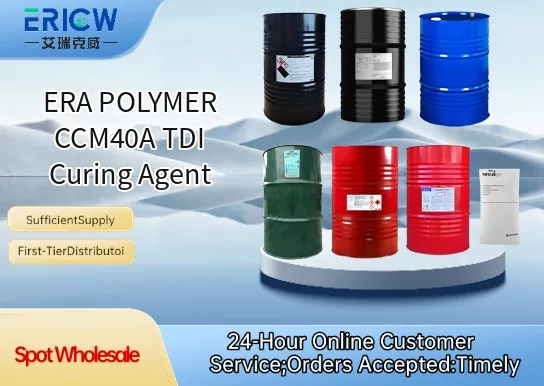
Q1: What is the primary function of ERA POLYMER CCM40A in polyurethane systems?
A: CCM40A is a TDI-based aromatic curing agent designed to react with hydroxyl-terminated prepolymers or resins, enabling rapid crosslinking and development of high mechanical strength, abrasion resistance, and thermal stability in final polyurethane elastomers and coatings.
Q2: Is CCM40A compatible with aliphatic polyol blends or only aromatic systems?
A: While optimized for use with aromatic isocyanate prepolymers, CCM40A demonstrates broad compatibility with both aromatic and aliphatic polyol-based systems. However, cure speed and final properties may vary depending on polyol functionality, molecular weight, and formulation pH.
Q3: How should CCM40A be handled and stored to maintain reactivity?
A: Store in tightly sealed containers under dry, inert atmosphere (e.g., nitrogen blanket) at temperatures between 15–25°C. Avoid prolonged exposure to moisture, heat, or ambient air—hydrolysis can lead to gelation or reduced curing efficiency.
Q4: Does CCM40A require catalysts for optimal performance?
A: Catalysts such as dibutyltin dilaurate (DBTDL) or tertiary amines are not mandatory but are commonly used to fine-tune pot life and cure profile. The choice and dosage depend on processing conditions, desired demold time, and end-use performance requirements.
Contact With Us:
E-mail: wangxingqiang@ericwchem.com
Have a Questions? Call Us:
Add:
Building A1, Jiete Industrial Park, Huangpu District, Guangzhou City, Guangdong Province, China