English
 Español
 tiếng việt
 русский
Broad-spectrum efficacy against bacteria, fungi, and algae in water-based systems.
Excellent stability in high-pH and hard-water conditions typical of industrial coolant formulations.
Low volatility and minimal odor, enhancing workplace safety and operator acceptance.
Compatible with common corrosion inhibitors, defoamers, and emulsifiers used in metalworking fluids.
Non-oxidizing mode of action, reducing risk of system component degradation and pitting corrosion.
Metalworking fluid concentrates and ready-to-use coolants.
Industrial process water systems, including closed-loop recirculating coolants.
Latex paint and architectural coatings preservation.
Water-based adhesives and sealants.
Oil-in-water emulsions used in textile and leather processing auxiliaries.
| Chemical Type | Isothiazolinone-based biocide blend (predominantly 2-methylisothiazolin-3-one and 5-chloro-2-methyl-4-isothiazolin-3-one) |
| Product Form | Aqueous solution |
| Appearance | Clear, pale yellow liquid |
| pH (1% aqueous solution) | 2.5 – 4.0 |
| Density (20°C) | 1.08 – 1.12 g/cm³ |
| Solubility | Completely miscible with water and most polar organic solvents |
| Primary Applications | Preservation of water-based industrial fluids and coatings |
| Key Features | Broad-spectrum antimicrobial activity, low use concentration, thermal and hydrolytic stability |
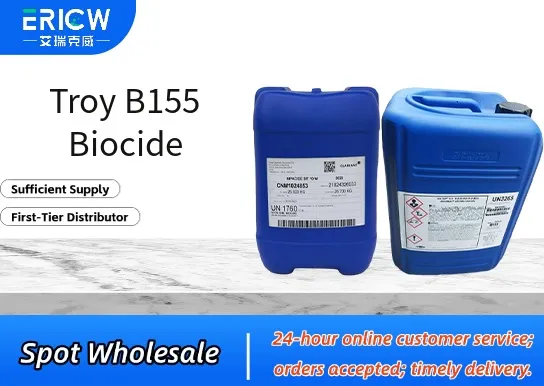
Q1: What types of microorganisms does Troy B155 Biocide effectively control?
A: Troy B155 Biocide is a broad-spectrum preservative designed to inhibit the growth of bacteria, yeasts, and molds commonly encountered in water-based industrial formulations, including both Gram-positive and Gram-negative strains.
Q2: In which product categories is Troy B155 Biocide typically used?
A: It is widely employed in water-based coatings, adhesives, construction chemicals, metalworking fluids, and industrial cleaners—particularly where long-term microbial stability and low odor are required.
Q3: How stable is Troy B155 Biocide under varying pH and temperature conditions?
A: Troy B155 exhibits good stability across a typical industrial pH range of approximately 4–10 and maintains efficacy during standard storage and processing temperatures; however, prolonged exposure to extreme heat or highly alkaline environments may reduce its performance over time.
Q4: Is Troy B155 Biocide compatible with common formulation ingredients?
A: Yes—it demonstrates broad compatibility with surfactants, thickeners, dispersants, and many water-soluble polymers, though compatibility testing is recommended when introducing new raw materials or at high active concentrations.
Contact With Us:
E-mail: wangxingqiang@ericwchem.com
Have a Questions? Call Us:
Add:
Building A1, Jiete Industrial Park, Huangpu District, Guangzhou City, Guangdong Province, China