English
 Español
 tiếng việt
 русский
Excellent abrasion resistance for demanding mechanical environments.
High elasticity and outstanding rebound resilience at room temperature.
Good low-temperature flexibility down to –30 °C.
Processable via standard thermoplastic methods including extrusion, injection molding, and calendering.
Compatible with common engineering plastics for co-extrusion and overmolding applications.
Industrial rollers and conveyor belts requiring wear-resistant surfaces.
Dynamic automotive components such as dust caps, grommets, and suspension bushings.
High-performance footwear midsoles and outsoles.
Flexible hoses and tubing for pneumatic and hydraulic systems.
Consumer electronics protective casings and soft-touch grips.
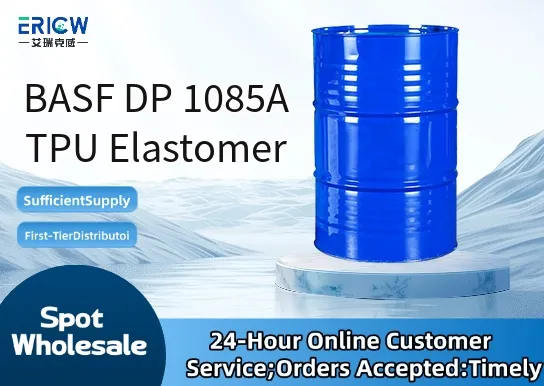
| Chemical Type | Thermoplastic Polyurethane (TPU), polyester-based |
| Product Form | Pellets |
| Appearance | Off-white to light beige, free-flowing granules |
| Hardness (Shore A) | 85 ± 2 |
| Melt Flow Index (210 °C / 2.16 kg) | 12–16 g/10 min |
| Density | 1.18–1.20 g/cm³ |
| Primary Applications | Dynamic elastomeric parts, industrial wear components, overmolded assemblies |
| Key Features | High tensile strength, excellent tear resistance, good oil and grease resistance |
Q1: What is the primary application domain for BASF DP 1085A TPU Elastomer?
A: BASF DP 1085A is a thermoplastic polyurethane elastomer specifically engineered for extrusion and injection molding applications requiring excellent melt stability, good clarity, and balanced mechanical properties—commonly used in high-performance tubing, thin-walled profiles, and medical-grade flexible components.
Q2: Is DP 1085A suitable for medical device manufacturing?
A: While DP 1085A is not pre-certified for direct patient contact, it is formulated without plasticizers or heavy-metal catalysts and meets common requirements for biocompatibility screening. End-use compliance depends on full device-level validation per applicable regulatory pathways (e.g., ISO 10993), including extraction and cytotoxicity testing.
Q3: How should DP 1085A be dried prior to processing?
A: Effective drying is critical due to TPU’s hygroscopic nature. A desiccant dryer operating at 70–80 °C with dew point ≤ −40 °C is recommended for 3–4 hours before processing. Inadequate drying may lead to surface defects, reduced tensile strength, and compromised optical clarity.
Q4: Can DP 1085A be blended with other polymers?
A: DP 1085A exhibits limited compatibility with non-polar resins such as polyolefins but shows better miscibility with other TPUs or certain polyester-based thermoplastics. Blending requires careful evaluation of phase morphology, thermal stability, and end-use performance—compatibilizers or reactive processing aids may be necessary for stable blends.
Contact With Us:
E-mail: wangxingqiang@ericwchem.com
Have a Questions? Call Us:
Add:
Building A1, Jiete Industrial Park, Huangpu District, Guangzhou City, Guangdong Province, China