English
 Español
 tiếng việt
 русский
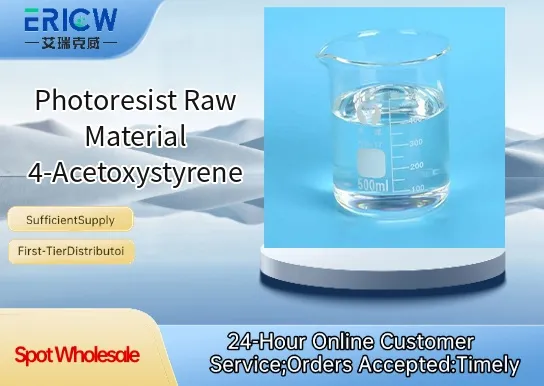
Highly reactive vinyl monomer enabling efficient copolymerization with styrenic and (meth)acrylic backbones.
Thermally labile acetate protecting group allows precise deprotection under mild acid-catalyzed conditions during post-exposure bake.
Excellent solubility in common photoresist casting solvents including propylene glycol monomethyl ether acetate (PGMEA) and ethyl lactate.
Low volatility and high purity (>99.5%) minimize outgassing and defect formation in high-resolution lithographic processes.
Consistent batch-to-batch performance validated by rigorous QC testing per ISO 9001 protocols.
Chemically amplified resists (CARs) for advanced semiconductor manufacturing at 193 nm and EUV nodes.
Photoacid generator (PAG)-containing resist formulations requiring acid-labile dissolution inhibitors.
Surface-imaging and bilayer resist systems for high-aspect-ratio patterning in MEMS and packaging applications.
Customizable polymer platforms for next-generation resist development in R&D laboratories.
Functional monomer in hybrid organic-inorganic resists for improved etch resistance and thermal stability.
| Chemical Type | Vinyl aromatic monomer, acid-labile protected phenol derivative |
| Product Form | Crystalline solid (free-flowing powder or fine crystals) |
| Appearance | White to off-white crystalline powder |
| Melting Point | 68–72 °C (determined by DSC, onset) |
| Purity (GC) | ≥99.5% |
| Residual Solvents (by GC) | <0.1% total (meets ICH Q3C Class 3 limits) |
| Key Features | Acid-labile acetoxy group, high reactivity in free-radical polymerization, low metal ion content (<5 ppm Na, K, Fe) |
| Regulatory Compliance | REACH registered; RoHS compliant; no SVHCs listed per current ECHA Candidate List |
| Common Compatible Systems | Suitability |
| Polystyrene-based CAR resins (e.g., PHS derivatives) | Highly Recommended – Excellent copolymerization efficiency and controlled deprotection kinetics |
| Acrylate/methacrylate copolymer matrices (e.g., MAA/MAA-tert-butyl ester) | Recommended – Requires optimized initiator and thermal cure profile |
| Novolac resin blends (with appropriate PAG and sensitizer) | Suitable – Effective as dissolution inhibitor modifier in g-line/i-line resists |
| EB-curable resist precursors | Recommended – Stable under inert atmosphere; compatible with electron beam crosslinking |
Q1: What is the CAS Registry Number for 4-Acetoxystyrene?
A: The CAS Number is 2628-16-2.
Q2: What is the typical loading range in photoresist formulations?
A: Standard incorporation is 5–20 wt% relative to the base polymer, depending on desired dissolution inhibition strength and resolution requirements.
Q3: How does 4-Acetoxystyrene compare to 4-Hydroxystyrene or tert-butoxystyrene in resist performance?
A: Unlike 4-Hydroxystyrene, it avoids premature hydrogen bonding and aggregation; versus tert-butoxystyrene, it offers faster deprotection kinetics and lower decomposition temperature, enhancing sensitivity without sacrificing thermal stability during pre-bake.
Q4: Is 4-Acetoxystyrene compliant with semiconductor industry migration control standards (e.g., SEMI S2/S8)?
A: Yes — certified for low extractables (<10 ppb in PGMEA under SEMI C17 test conditions) and meets SEMI S2 safety guidelines for handling and storage.
Q5: Can it be used in aqueous-developable resists?
A: Not directly — its hydrophobic nature requires co-monomer design (e.g., with acrylic acid or maleic anhydride) to achieve sufficient aqueous alkaline solubility after deprotection; recommended for solvent-developable systems unless specifically modified.
Contact With Us:
E-mail: wangxingqiang@ericwchem.com
Have a Questions? Call Us:
Add:
Building A1, Jiete Industrial Park, Huangpu District, Guangzhou City, Guangdong Province, China