English
 Español
 tiếng việt
 русский
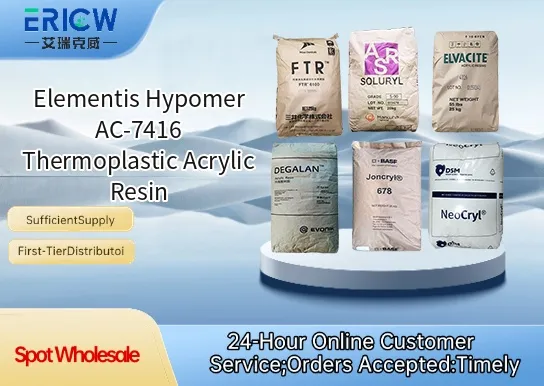
High molecular weight thermoplastic acrylic resin offering excellent film-forming capability and cohesive strength.
Provides outstanding gloss retention, clarity, and UV resistance in demanding outdoor applications.
Compatible with a broad range of solvents including ketones, esters, and aromatic hydrocarbons.
Delivers balanced hardness and flexibility for durable, abrasion-resistant coatings.
Low color and high thermal stability support consistent performance in heat-sensitive processing environments.
Automotive refinish clearcoats and basecoat binders.
Industrial maintenance coatings for metal and plastic substrates.
High-performance coil coatings requiring excellent weatherability and gloss retention.
Architectural clear topcoats for aluminum extrusions and façade systems.
Specialty inks for flexible packaging and decorative printing.
| Chemical Type | Thermoplastic acrylic copolymer |
| Product Form | Powder or flake (solvent-soluble) |
| Appearance | White to off-white free-flowing solid |
| Solubility | Soluble in methyl ethyl ketone (MEK), methyl isobutyl ketone (MIBK), xylene, and ethyl acetate |
| Glass Transition Temperature (Tg) | Approx. 105–110 °C (by DSC) |
| Acid Number | < 5 mg KOH/g |
| Color (Gardner) | < 3 |
| Volatile Content | < 0.5% at 105 °C |
Q1: What is the primary function of Hypomer AC-7416 in coating and ink formulations?
A: Hypomer AC-7416 functions primarily as a thermoplastic acrylic resin modifier that enhances film formation, improves surface hardness and mar resistance, and contributes to gloss retention and substrate adhesion—particularly in solvent-based and high-solids systems.
Q2: Is Hypomer AC-7416 compatible with common crosslinkers used in thermosetting systems?
A: Yes, Hypomer AC-7416 exhibits good compatibility with melamine-formaldehyde and urea-formaldehyde resins, as well as with blocked isocyanates, enabling its use in hybrid thermoplastic–thermoset formulations where balanced cure speed and film flexibility are required.
Q3: How does Hypomer AC-7416 differ from conventional solution acrylic resins in terms of processing?
A: As a thermoplastic acrylic resin, Hypomer AC-7416 offers melt-processability and film-forming capability without chemical crosslinking, making it suitable for applications requiring thermal reversibility, such as overprint varnishes or reworkable coatings—unlike thermoset acrylics that undergo irreversible curing.
Q4: What solvents are recommended for dissolving Hypomer AC-7416?
A: Hypomer AC-7416 dissolves readily in common organic solvents including aromatic hydrocarbons (e.g., xylene), ketones (e.g., MEK, acetone), and esters (e.g., ethyl acetate), and shows limited solubility in alcohols and water—solvent selection should consider formulation VOC targets and evaporation rate requirements.
Contact With Us:
E-mail: wangxingqiang@ericwchem.com
Have a Questions? Call Us:
Add:
Building A1, Jiete Industrial Park, Huangpu District, Guangzhou City, Guangdong Province, China