English
 Español
 tiếng việt
 русский
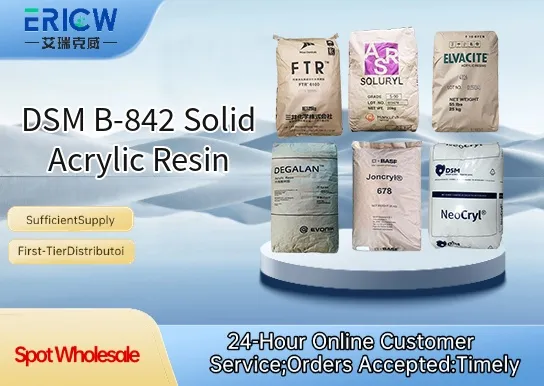
High molecular weight thermoplastic acrylic polymer offering excellent clarity and gloss retention.
Outstanding UV resistance and weatherability for long-term outdoor performance.
Good solubility in common organic solvents including toluene, xylene, and ethyl acetate.
Low yellowing tendency and high thermal stability up to 180 °C (short-term).
Consistent particle size distribution enabling smooth film formation and easy processing.
Automotive clearcoats and OEM topcoats requiring high durability and depth of image.
Industrial maintenance coatings for metal and plastic substrates.
Architectural coatings including façade finishes and protective gloss layers.
UV-curable hybrid systems as a reactive diluent or film-forming binder modifier.
Specialty inks for flexible packaging and high-end decorative printing.
| Chemical Type | Thermoplastic solid acrylic copolymer |
| Product Form | Free-flowing granular solid |
| Appearance | White to off-white granules |
| Typical Glass Transition Temperature (Tg) | 105–110 °C (DSC, 10 °C/min) |
| Acid Value | < 5 mg KOH/g |
| Volatile Organic Content (VOC) | < 0.5% (by weight) |
| Primary Applications | High-performance coatings, clearcoats, industrial finishes |
| Key Features | Clarity, UV stability, solvent solubility, thermal robustness |
Q1: What is the primary function of DSM B-842 in coating and ink formulations?
A: DSM B-842 is a solid acrylic resin designed to act as a rheology modifier and film-forming aid, enhancing viscosity control, improving leveling, and contributing to gloss development and surface hardness in solvent-based and high-solids coatings and printing inks.
Q2: Is DSM B-842 compatible with common organic solvents and resin systems?
A: Yes, DSM B-842 exhibits good compatibility with typical aromatic and aliphatic hydrocarbons, ketones, esters, and alcohols, and is widely used alongside alkyd, polyester, epoxy, and other acrylic resins without significant risk of haze or phase separation.
Q3: How should DSM B-842 be incorporated into a formulation?
A: It is typically added during the let-down or post-addition stage under moderate agitation. Pre-dispersion in a suitable solvent or carrier resin is recommended to ensure uniform distribution and avoid agglomeration, especially in high-viscosity systems.
Q4: Does DSM B-842 require thermal curing to develop full performance?
A: No, DSM B-842 functions primarily through physical film formation and does not rely on chemical crosslinking. Full property development occurs upon solvent evaporation and ambient or forced-air drying, though elevated temperatures may accelerate film coalescence.
Q5: What are key handling and storage recommendations for DSM B-842?
A: Store in a cool, dry place away from direct sunlight and sources of heat. Keep containers tightly sealed to prevent moisture absorption and dust contamination. Avoid prolonged exposure to high humidity, which may affect flow properties during handling.
Contact With Us:
E-mail: wangxingqiang@ericwchem.com
Have a Questions? Call Us:
Add:
Building A1, Jiete Industrial Park, Huangpu District, Guangzhou City, Guangdong Province, China