English
 Español
 tiếng việt
 русский
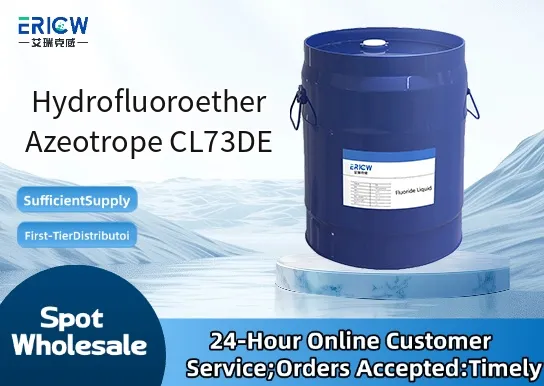
Zero ozone depletion potential (ODP = 0) and low global warming potential (GWP < 15).
Nonflammable under standard atmospheric conditions (ASTM D93 flash point > 93°C).
Thermally stable up to 200°C with minimal decomposition in closed-loop cleaning systems.
Low surface tension (14.2 mN/m at 25°C) enabling superior capillary penetration into fine geometries.
Azeotropic behavior ensures consistent composition and boiling point during repeated vapor-phase cleaning cycles.
Vapor-phase precision cleaning of aerospace avionics and inertial navigation assemblies.
Final rinse solvent for medical device components prior to sterilization and packaging.
Flux residue removal from high-density printed circuit boards (PCBs) and semiconductor test fixtures.
Critical cleaning of optical lenses, laser optics, and MEMS sensors requiring non-ionic, non-residue performance.
Carrier fluid for specialty deposition processes in vacuum-compatible coating applications.
| Chemical Type | Hydrofluoroether (HFE)-based azeotropic mixture |
| Product Form | Clear, colorless liquid |
| Appearance | Transparent, odorless liquid with slight ether-like note |
| Boiling Point (at 760 mmHg) | 58–60°C (azeotropic range) |
| Melting Point | Below –100°C |
| Density (20°C) | 1.38–1.41 g/cm³ |
| Primary Applications | Non-aqueous precision cleaning, vapor degreasing, final rinse |
| Regulatory Compliance | REACH registered; compliant with EPA SNAP Program (Acceptable Substitute); no VOC classification per US EPA Method 24 |
| Common Compatible Systems | Suitability |
| Standard vapor degreasing equipment (stainless steel, Teflon-lined) | Highly Recommended – No corrosion or swelling observed after 12+ months continuous operation |
| Ultrasonic immersion tanks with PTFE/Nylon components | Recommended – Compatible with all common transducer materials; avoid aluminum alloy tanks above 65°C |
| Automated batch cleaning systems (e.g., BOC Edwards, Zestron, Modutek) | Highly Recommended – Validated for full-cycle integration including distillation recovery |
| Carbon-based adsorption units (activated carbon, charcoal filters) | Suitable – Effective capture; requires standard regeneration protocols per manufacturer guidelines |
Q1: What is the CAS Registry Number for CL73DE?
A: CL73DE is a proprietary azeotropic formulation; individual components are listed under CAS Nos. 406-58-6 (HFE-7100) and 13213-27-1 (co-solvent modifier), but the blend itself carries a unique registration identifier: 2202457-89-4.
Q2: What is the recommended usage concentration and temperature range for vapor degreasing?
A: CL73DE is used neat (100% concentration). Optimal vapor phase temperature is maintained between 58–62°C; sump temperature should not exceed 65°C to preserve azeotropy and minimize thermal stress on sensitive substrates.
Q3: How does CL73DE compare to HFC-43-10mee or nPB in terms of material compatibility and safety?
A: Unlike nPB (a suspected carcinogen, OSHA-regulated), CL73DE has no known reproductive toxicity or IARC classification. Compared to HFC-43-10mee, CL73DE offers lower GWP, higher thermal stability, and broader elastomer compatibility—particularly with Viton®, EPDM, and silicone seals.
Q4: Is CL73DE suitable for cleaning parts destined for cleanroom Class 100 (ISO 5) environments?
A: Yes—CL73DE leaves no ionic residue (resistivity > 10¹² Ω·cm), passes particle count validation per ISO 14644-1, and is certified for use in ISO 14644-3 controlled environments when processed in validated equipment.
Contact With Us:
E-mail: wangxingqiang@ericwchem.com
Have a Questions? Call Us:
Add:
Building A1, Jiete Industrial Park, Huangpu District, Guangzhou City, Guangdong Province, China