English
 Español
 tiếng việt
 русский
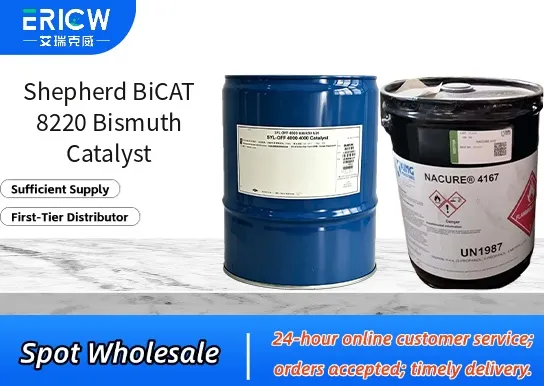
Highly selective bismuth-based catalyst for polyurethane foam production with minimal side reactions.
Low toxicity profile compared to traditional tin or amine catalysts, supporting safer handling and regulatory compliance.
Excellent storage stability — remains homogeneous and active for ≥12 months under recommended conditions.
Water-soluble formulation enabling uniform dispersion in aqueous polyol systems without phase separation.
Enables precise control over cream-to-gel timing, improving process consistency in flexible slabstock foam manufacturing.
Flexible polyurethane slabstock foam for bedding and furniture.
Integral skin foam for automotive seating and trim components.
High-resiliency (HR) foam requiring balanced reactivity and cell structure control.
Water-blown foam formulations targeting low-VOC and sustainable product certifications.
Multi-component spray-applied insulation foams with extended pot life requirements.
| Chemical Type | Bismuth carboxylate complex |
| Product Form | Clear, amber liquid |
| Appearance | Homogeneous solution, free of sediment or cloudiness |
| Specific Gravity (25°C) | 1.25–1.30 g/cm³ |
| Viscosity (25°C) | 150–250 cP |
| pH (1% aqueous solution) | 4.5–5.5 |
| Solubility | Miscible with common polyols and water |
| Recommended Storage | Keep container tightly closed; store at 10–30°C, avoid freezing |
Q1: What is the primary function of Shepherd BiCAT 8220 in polyurethane systems?
A: Shepherd BiCAT 8220 is a bismuth-based catalyst designed to promote urethane (polyol–isocyanate) reaction kinetics while offering significantly reduced toxicity and regulatory burden compared to traditional tin-based catalysts like dibutyltin dilaurate (DBTDL). It provides balanced gelling and blowing activity, supporting good flow, demold time control, and final part integrity in flexible and rigid foams, coatings, and adhesives.
Q2: How does BiCAT 8220 compare to tin catalysts in terms of shelf life and formulation stability?
A: BiCAT 8220 demonstrates excellent hydrolytic and thermal stability in typical polyurethane formulations. Unlike many organotin compounds, it is not prone to deactivation by moisture or acidic components, contributing to longer pot life and improved batch-to-batch consistency—especially in moisture-sensitive or high-solid systems.
Q3: Is BiCAT 8220 suitable for use in low-VOC or bio-based polyurethane formulations?
A: Yes—BiCAT 8220 is compatible with a wide range of low-VOC solvents, waterborne dispersions, and bio-derived polyols (e.g., soy-, castor-, or sucrose-based). Its low volatility and absence of heavy metal restrictions associated with tin make it a preferred choice for formulators targeting sustainable, regulatory-compliant product lines.
Q4: What is the typical dosage range for BiCAT 8220 in polyurethane applications?
A: Dosage depends on formulation requirements, desired reactivity profile, and co-catalyst strategy—but BiCAT 8220 is typically used at low concentrations, generally ranging from 0.1% to 2% by weight relative to the total polyol component. Optimization is recommended via small-scale trials to balance cure speed, foam structure, and physical properties.
Q5: Can BiCAT 8220 be used as a direct replacement for DBTDL without reformulation?
A: While BiCAT 8220 is often selected as a drop-in alternative to DBTDL for regulatory and safety reasons, full functional equivalence cannot be assumed. Reactivity profiles differ, and optimal performance may require minor adjustments to catalyst loading, amine co-catalyst selection, or processing conditions. Pilot testing is strongly advised before full-scale substitution.
Contact With Us:
E-mail: wangxingqiang@ericwchem.com
Have a Questions? Call Us:
Add:
Building A1, Jiete Industrial Park, Huangpu District, Guangzhou City, Guangdong Province, China