English
 Español
 tiếng việt
 русский
High thermal stability up to 250 °C continuous service temperature.
Excellent electrical insulation properties with low dielectric loss.
Good compatibility with organic resins and inorganic fillers for hybrid formulations.
Low surface energy enabling superior release performance and hydrophobicity.
Solvent-based liquid format facilitating easy integration into coating and impregnation processes.
High-temperature insulating varnishes for electric motors and transformers.
Matrix resin for ceramic-filled composites used in aerospace thermal management components.
Binders in refractory coatings for industrial furnace linings.
Surface modifiers for glass fiber reinforcements in high-performance composites.
Base resin in flame-retardant, heat-resistant architectural sealants.
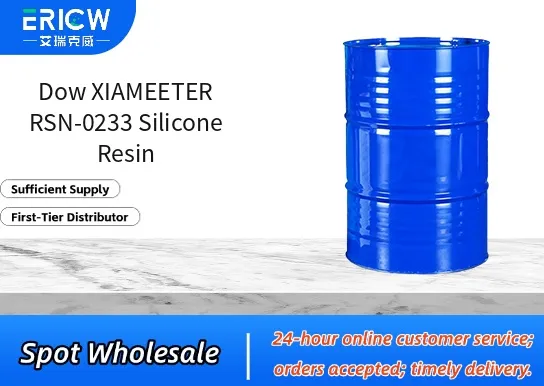
| Chemical Type | Methyl-phenyl silicone resin |
| Product Form | Liquid solution (toluene/xylene solvent system) |
| Appearance | Clear, colorless to pale yellow viscous liquid |
| Solids Content | 60 ± 2 wt% |
| Viscosity (25 °C, Brookfield LVT, spindle #3, 12 rpm) | 8,000–12,000 cP |
| Density (25 °C) | 0.94–0.97 g/cm³ |
| Flash Point (COC) | 42–48 °C |
| Key Features | Thermally stable, electrically insulating, hydrophobic, solvent-soluble |
Q1: What is the primary function of XIAMEETER RSN-0233 in coating formulations?
A: XIAMEETER RSN-0233 is a methyl-phenyl silicone resin designed to enhance thermal stability, weather resistance, and surface hardness in high-performance coatings—particularly for metal substrates exposed to elevated temperatures or harsh environmental conditions.
Q2: Is RSN-0233 compatible with organic resin systems such as acrylics or polyesters?
A: Yes, RSN-0233 exhibits good compatibility with many thermosetting organic resins—including acrylics, alkyds, and polyester-based systems—enabling hybrid formulations that balance silicone performance benefits with cost-effective processing and film integrity.
Q3: How is RSN-0233 typically incorporated into a formulation?
A: It is generally added during the let-down stage under moderate agitation and is soluble in common aromatic and ketonic solvents. Dosage depends on formulation requirements but typically ranges from 0.1% to 2% by weight relative to total solids to achieve optimal performance enhancement without compromising viscosity or cure behavior.
Q4: Does RSN-0233 require a catalyst or post-cure to develop its full properties?
A: While RSN-0233 can contribute functionality in ambient-cured systems, its thermal stability and crosslink density are maximized when used in heat-cured applications—typically above 150 °C. Catalysts such as tin or titanium compounds may be used to accelerate cure, depending on the base resin system and target processing window.
Contact With Us:
E-mail: wangxingqiang@ericwchem.com
Have a Questions? Call Us:
Add:
Building A1, Jiete Industrial Park, Huangpu District, Guangzhou City, Guangdong Province, China