English
 Español
 tiếng việt
 русский
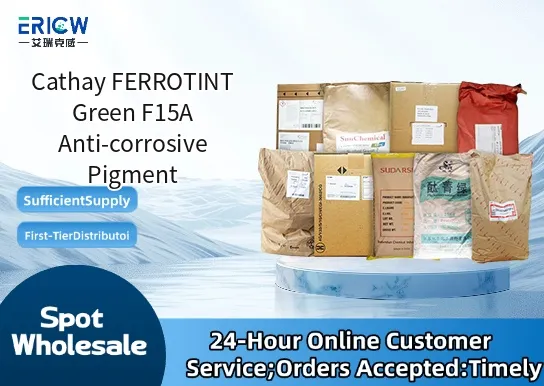
Environmentally compliant alternative to heavy-metal-based anti-corrosive pigments.
Provides excellent passivation and barrier protection for ferrous substrates.
Enhances long-term corrosion resistance in both epoxy and alkyd coating systems.
Offers good dispersion stability and minimal impact on coating rheology.
Delivers consistent green hue without compromising pigment volume concentration (PVC) performance.
Marine and offshore structural coatings.
Industrial maintenance coatings for steel infrastructure.
Heavy-duty protective coatings for power generation equipment.
Anti-corrosive primers for bridges and pipelines.
Water tank and reservoir interior linings.
| Chemical Type | Modified orthophosphate-based complex |
| Product Form | Fine dry powder |
| Appearance | Greenish-gray free-flowing powder |
| Primary Applications | Anti-corrosive primer pigments for protective coatings |
| Key Features | Passivation, low water solubility, pH-neutral |
| Benefits | Reduced zinc usage, RoHS-compliant, compatible with common resin systems |
| Density (g/cm³) | 3.2–3.5 |
| Particle Size (D50, μm) | 2.5–4.0 |
Q1: What is the primary corrosion-inhibition mechanism of Cathay FERROTINT Green F15A?
A: Cathay FERROTINT Green F15A functions primarily through passive film formation on ferrous metal surfaces, leveraging its modified orthophosphate-based chemistry to promote stable oxide layer development and reduce electrochemical activity at the metal–coating interface.
Q2: Is this pigment compatible with waterborne industrial coatings?
A: Yes — Cathay FERROTINT Green F15A is specifically engineered for compatibility with both solvent-borne and waterborne epoxy, acrylic, and polyurethane systems, including high-solids and low-VOC formulations commonly used in protective coatings.
Q3: How does F15A differ from conventional zinc phosphate pigments?
A: Unlike traditional zinc phosphates, F15A features a surface-modified particle structure that enhances dispersion stability, reduces sedimentation risk, and improves interfacial interaction with resin matrices—resulting in more consistent anti-corrosive performance across varying film thicknesses and curing conditions.
Q4: What is the typical dosage range when formulating primers with this pigment?
A: Dosage depends on formulation requirements and performance targets, but it is typically used at low concentrations—generally ranging from 0.1% to 2% by weight of the total coating system—to balance efficacy, cost, and rheological behavior without compromising film integrity.
Contact With Us:
E-mail: wangxingqiang@ericwchem.com
Have a Questions? Call Us:
Add:
Building A1, Jiete Industrial Park, Huangpu District, Guangzhou City, Guangdong Province, China