English
 Español
 tiếng việt
 русский
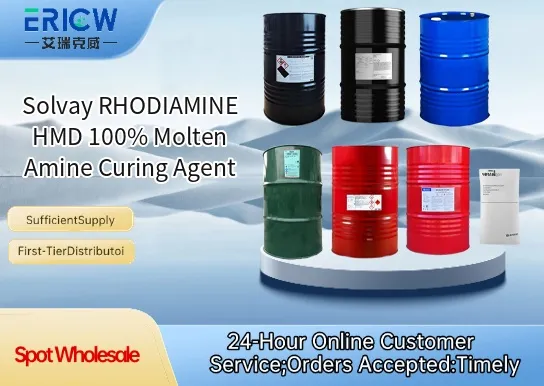
High-purity, 100% molten hexamethylenediamine (HMD) with no solvents or diluents.
Low viscosity and excellent flow characteristics for seamless integration into epoxy resin systems.
Enables rapid cure kinetics at ambient to moderate elevated temperatures (20–80 °C).
Delivers superior thermal stability and glass transition temperature (Tg) in cured epoxy networks.
Compatible with standard epoxy resins including DGEBA, DGEBF, and novolac epoxies.
High-performance structural adhesives for aerospace and automotive bonding.
Electrical encapsulation and potting compounds requiring low moisture absorption.
Composite matrix resins for carbon fiber reinforced polymer (CFRP) prepregs.
Advanced coating systems for corrosion-resistant industrial linings and tank linings.
Tooling and casting resins demanding dimensional stability and low exotherm.
| Chemical Type | Aliphatic diamine (1,6-hexamethylenediamine) |
| Product Form | 100% molten liquid (no solvent, no additives) |
| Appearance | Clear, colorless to pale yellow liquid |
| Primary Applications | Epoxy resin curing agent for high-Tg, low-moisture, structural systems |
| Key Features | High reactivity, low volatility, excellent stoichiometric control |
| Benefits | Improved mechanical performance, reduced post-cure requirements, enhanced chemical resistance |
| Storage Condition | Store under dry nitrogen, protected from moisture and CO2 |
| Handling Precaution | Use in well-ventilated areas; wear appropriate PPE (gloves, goggles, respirator) |
Q1: What is the primary function of RHODIAMINE HMD in epoxy systems?
A: RHODIAMINE HMD is a highly reactive, low-viscosity molten amine curing agent designed to initiate and drive the crosslinking reaction of epoxy resins, delivering enhanced thermal stability, chemical resistance, and mechanical performance in cured networks.
Q2: How does RHODIAMINE HMD differ from conventional solid amine hardeners?
A: Unlike many crystalline or powder-based amine hardeners, RHODIAMINE HMD is supplied as a homogeneous, pumpable molten liquid at ambient handling temperatures, enabling simplified metering, improved mixing efficiency, and reduced risk of dust exposure during industrial processing.
Q3: Is RHODIAMINE HMD compatible with standard epoxy resins used in composites and coatings?
A: Yes — RHODIAMINE HMD demonstrates broad compatibility with common diglycidyl ether of bisphenol-A (DGEBA) and bisphenol-F (DGEBF) epoxy resins, as well as many novolac and cycloaliphatic epoxies, making it suitable for structural adhesives, composite matrices, and high-performance protective coatings.
Q4: What are typical handling and storage recommendations for RHODIAMINE HMD?
A: RHODIAMINE HMD should be stored under dry, inert conditions at moderate temperatures (15–30 °C) and protected from moisture and strong oxidizing agents. Due to its reactivity, prolonged exposure to air may lead to surface skinning; therefore, nitrogen blanketing of storage tanks is recommended for extended shelf life.
Q5: How is the stoichiometric ratio typically determined when formulating with RHODIAMINE HMD?
A: The optimal amine-to-epoxy ratio is best established experimentally based on the target performance profile, but initial formulations often start near the theoretical amine hydrogen equivalent weight (AHEW)-to-epoxy equivalent weight (EEW) ratio, adjusted iteratively for cure kinetics, pot life, and final properties.
Contact With Us:
E-mail: wangxingqiang@ericwchem.com
Have a Questions? Call Us:
Add:
Building A1, Jiete Industrial Park, Huangpu District, Guangzhou City, Guangdong Province, China