English
 Español
 tiếng việt
 русский
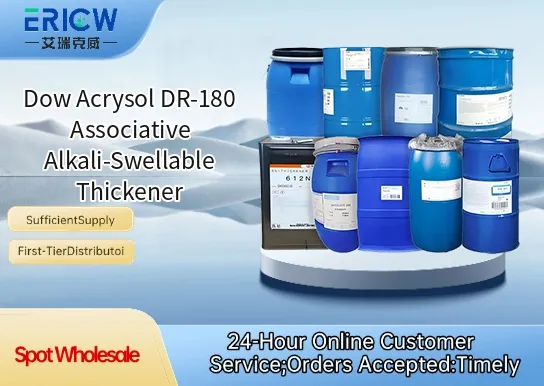
Delivers high mid-shear viscosity for excellent sag resistance and brush/roller drag in architectural coatings.
Provides superior flow and leveling while maintaining robust spatter resistance in waterborne formulations.
Offers exceptional compatibility with surfactants, co-thickeners, and common paint additives.
Delivers consistent rheology performance across a broad pH range (pH 7.5–10.5) after neutralization.
Enables low VOC and zero APEO formulations without compromising thickening efficiency or stability.
Interior and exterior architectural flat and low-sheen latex paints.
Textured decorative coatings and plaster-based finishes.
Waterborne primers and undercoats requiring controlled rheology.
Industrial maintenance coatings for metal and masonry substrates.
Acrylic-based sealers and clear topcoats where clarity and film integrity are critical.
| Chemical Type | Associative alkali-swellable acrylic copolymer |
| Product Form | Aqueous dispersion |
| Appearance | Opaque white liquid |
| pH (as received) | 2.5–4.0 |
| Solids Content (wt%) | 28.0–30.0 |
| Viscosity (Brookfield RVT, spindle #3, 20 rpm, 25°C) | 500–2,500 cP |
| Primary Applications | Architectural and industrial waterborne coatings |
| Key Features | Non-ionic associative thickening, shear-thinning behavior, low foaming |
Q1: How does DR-180 differ from conventional non-associative alkali-swellable thickeners (ASE)?
A: Unlike traditional ASE thickeners, DR-180 is an associative alkali-swellable thickener (A-ASE), meaning it contains hydrophobic groups that enable intermolecular association in addition to electrostatic swelling. This provides superior rheology control—especially enhanced mid-shear viscosity, better sag resistance, and improved leveling—while maintaining good water sensitivity and ease of incorporation.
Q2: What types of formulations is DR-180 most commonly used in?
A: DR-180 is widely used in high-performance architectural coatings—including interior and exterior flat and low-sheen paints—where balanced flow, leveling, and anti-sag properties are critical. It is also suitable for industrial maintenance coatings, primers, and some water-based wood finishes requiring robust rheological performance under varying shear conditions.
Q3: How should DR-180 be incorporated into a water-based formulation?
A: DR-180 is typically added during the let-down stage, after the pigment grind and neutralized with a suitable base (e.g., AMP-95 or NaOH) to pH ≥ 8.0 to initiate swelling. It is recommended to pre-dilute with water or formulation water before addition and ensure adequate mixing time to achieve full hydration and associative network development.
Q4: Is DR-180 compatible with common co-thickeners and rheology modifiers?
A: Yes, DR-180 generally exhibits good compatibility with cellulosic thickeners (e.g., HEC) and non-ionic polyurethane thickeners (HEUR), enabling hybrid rheology systems. However, compatibility testing is advised when combining with highly ionic additives, surfactants, or biocides, as these may influence its associative behavior or viscosity stability.
Contact With Us:
E-mail: wangxingqiang@ericwchem.com
Have a Questions? Call Us:
Add:
Building A1, Jiete Industrial Park, Huangpu District, Guangzhou City, Guangdong Province, China