English
 Español
 tiếng việt
 русский
Excellent abrasion resistance for demanding mechanical service life requirements.
High elasticity and outstanding rebound resilience across a wide temperature range.
Good oil, grease, and hydrocarbon resistance suitable for industrial environments.
Processable via standard thermoplastic methods including injection molding and extrusion.
Consistent melt flow behavior enabling reproducible part quality and dimensional stability.
Industrial rollers and conveyor belts requiring high wear resistance.
Automotive interior trim components such as gear shift knobs and armrest covers.
Flexible hoses and fluid handling tubing in hydraulic and pneumatic systems.
Protective casings and gaskets for electronic enclosures and portable devices.
Footwear midsoles and performance outsoles demanding dynamic flexibility and durability.
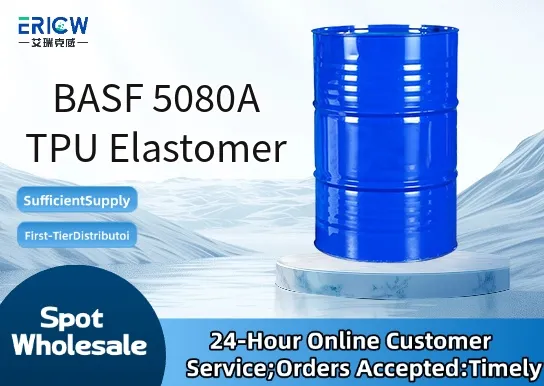
| Chemical Type | Thermoplastic Polyurethane (TPU), polyester-based |
| Product Form | Natural-colored granules |
| Appearance | Opaque, free-flowing pellets |
| Primary Applications | Extrusion, injection molding, calendering |
| Key Features | High tensile strength, excellent tear resistance, low compression set |
| Benefits | Recyclable, no vulcanization required, fast cycle times |
| Density (ISO 1183) | Approx. 1.20 g/cm³ |
| Melt Flow Index (ISO 1133, 210 °C/5 kg) | Approx. 12 g/10 min |
Q1: What is the primary processing method for BASF 5080A TPU Elastomer?
A: BASF 5080A is a thermoplastic polyurethane elastomer designed for melt-processing techniques, including extrusion, injection molding, and blow molding. It exhibits excellent melt stability and low viscosity at processing temperatures, enabling efficient shaping into films, profiles, and complex molded parts.
Q2: Is BASF 5080A suitable for applications requiring abrasion resistance and flexibility?
A: Yes — as a high-performance aliphatic TPU, 5080A delivers outstanding abrasion resistance, excellent elasticity, and good low-temperature flexibility. These properties make it well-suited for demanding dynamic applications such as industrial hoses, wear-resistant coatings, and flexible automotive components.
Q3: How does BASF 5080A compare to aromatic TPUs in terms of UV and hydrolytic stability?
A: Unlike aromatic TPUs, BASF 5080A features an aliphatic isocyanate backbone, which provides significantly improved resistance to UV-induced discoloration and long-term hydrolytic degradation. This makes it preferable for outdoor applications and environments with prolonged moisture exposure.
Q4: Can BASF 5080A be blended or compounded with other polymers?
A: Yes — 5080A demonstrates good compatibility with various engineering thermoplastics and elastomers, including certain grades of PC, ABS, and soft PVC, when properly formulated. Compatibility should be verified through preliminary trials, as phase separation may occur depending on thermal history and additive selection.
Q5: What drying conditions are recommended prior to processing?
A: To ensure optimal mechanical performance and surface quality, BASF 5080A should be dried thoroughly before processing. Typical drying involves circulating hot air at 80–90 °C for 2–4 hours, with residual moisture content maintained below 0.05% — exact time depends on material bulk depth and ambient humidity.
Contact With Us:
E-mail: wangxingqiang@ericwchem.com
Have a Questions? Call Us:
Add:
Building A1, Jiete Industrial Park, Huangpu District, Guangzhou City, Guangdong Province, China