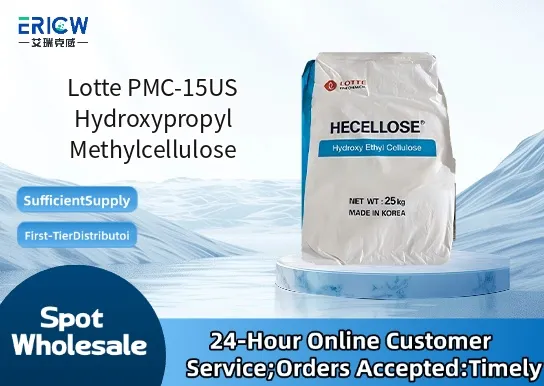
Features Of Lotte PMC-15US Hydroxypropyl Methylcellulose
Highly water-soluble with rapid dispersion and low gelation temperature for efficient cold-water dissolution.
Excellent film-forming capability, providing uniform, flexible, and transparent coatings in pharmaceutical and food matrices.
Superior thermal and shear stability across a broad pH range (3–11), ensuring consistent performance in demanding processing conditions.
Low microbial content and compliant with USP/NF and JP monographs for pharmaceutical-grade excipients.
Precisely controlled viscosity profile (15 mPa·s at 2% aqueous solution, 20°C) enabling reproducible rheology in formulation development.
Typical Applications Of Lotte PMC-15US Hydroxypropyl Methylcellulose
Immediate-release and sustained-release oral solid dosage forms (tablets, granules, and matrix tablets).
Topical gels and ophthalmic solutions requiring clarity, viscosity control, and non-irritating behavior.
Food-grade thickeners and stabilizers in dairy alternatives, sauces, and plant-based beverages.
Binders and film-coating agents in pharmaceutical tablet manufacturing.
Water-retention additives in tile adhesives and cement-based construction mortars.
Specifications Of Lotte PMC-15US Hydroxypropyl Methylcellulose
| Chemical Type | Non-ionic cellulose ether derivative |
| Product Form | White to off-white fine powder |
| Appearance | Free-flowing, odorless powder |
| Viscosity (2% aqueous solution, 20°C) | 14–16 mPa·s |
| Moisture Content | ≤ 5.0% (w/w) |
| pH (1% aqueous solution) | 5.0–8.0 |
| Sulfated Ash | ≤ 1.0% (w/w) |
| Microbial Limits (USP <61>) | Total aerobic count ≤ 1000 CFU/g; absence of E. coli, Salmonella, and S. aureus |
Lotte PMC-15US Hydroxypropyl Methylcellulose – Frequently Asked Questions (FAQ)
Q1: What is the primary functional role of Lotte PMC-15US in aqueous formulations?
A: Lotte PMC-15US functions primarily as a water-soluble thickener, rheology modifier, and film-forming agent. It imparts pseudoplastic flow behavior, improves suspension stability, and enhances surface adhesion in water-based systems such as coatings, adhesives, and construction mortars.
Q2: How does PMC-15US compare to other HPMC grades in terms of viscosity and thermal gelation behavior?
A: PMC-15US is a medium-viscosity grade with balanced cold-water solubility and delayed thermal gelation onset. Compared to higher-substitution or lower-molecular-weight HPMC variants, it offers improved workability at ambient temperatures and more predictable viscosity retention during moderate heating—making it suitable for applications requiring extended open time and controlled setting behavior.
Q3: Is PMC-15US compatible with common inorganic additives used in cementitious systems?
A: Yes, PMC-15US demonstrates good compatibility with typical cementitious system components—including Portland cement, calcium carbonate fillers, and redispersible polymer powders—without significant viscosity loss or phase separation under standard mixing conditions. Its performance remains stable across the pH range commonly encountered in fresh mortar and grout formulations.
Q4: What are recommended handling and dispersion practices to avoid lump formation?
A: To ensure smooth dispersion, PMC-15US should be gradually added to vigorously agitated cold water—preferably using high-shear mixing—to prevent agglomeration. Pre-blending with inert carriers like sugars or silicas can further aid uniform wetting. Avoid direct addition to hot water or static liquid, as rapid surface hydration may hinder full dissolution.
Q5: Can PMC-15US be used in food-contact or pharmaceutical-related applications?
A: Lotte PMC-15US is manufactured to industrial-grade specifications and is not certified for direct food or pharmaceutical use. For regulatory-compliant applications, customers should consult Lotte’s dedicated food-grade or pharma-grade HPMC product lines and obtain appropriate documentation prior to use.
 English
 Español
 tiếng việt
 русский