English
 Español
 tiếng việt
 русский
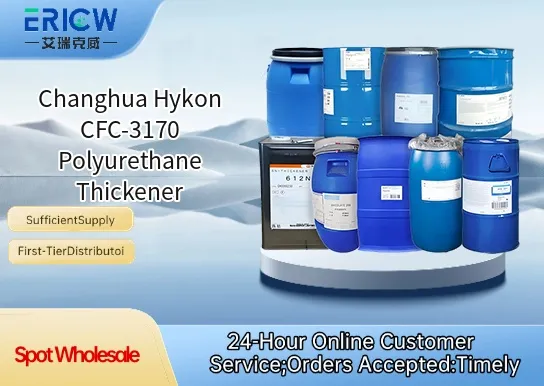
Non-ionic, associative rheology modifier delivering excellent viscosity build and shear-thinning behavior.
High compatibility with anionic and non-ionic surfactants commonly used in waterborne coatings and inks.
Provides outstanding sag resistance and leveling balance without compromising flow or gloss retention.
Low foaming profile—ideal for high-shear mixing and spray application processes.
Stable across broad pH range (pH 4–10), ensuring formulation robustness in diverse aqueous systems.
Architectural interior and exterior latex paints.
Industrial maintenance coatings for metal and concrete substrates.
Water-based wood stains and clear finishes.
Printing inks for flexographic and gravure processes.
Adhesives and sealants requiring controlled rheology and open-time management.
| Chemical Type | Hydrophobically modified polyurethane (HMPEU) |
| Product Form | Aqueous dispersion (non-solvent-based) |
| Appearance | Opaque, milky white liquid |
| pH (1% aqueous solution) | 6.5–7.5 |
| Active Content | 25.0 ± 1.0 wt% |
| Viscosity (Brookfield RVT, #3 spindle, 20 rpm, 25°C) | 1,500–3,500 cP |
| Freeze-Thaw Stability | Passes 3 cycles (−18°C/24 h → 25°C/24 h) |
| Storage Stability | ≥12 months at 5–30°C in unopened original container |
Q1: What type of rheology does CFC-3170 provide in waterborne polyurethane systems?
A: CFC-3170 delivers non-ionic, associative thickening behavior, offering excellent mid-shear viscosity control and good flow/leveling balance. It enhances sag resistance without significantly increasing low-shear viscosity, supporting stable application performance in coatings and adhesives.
Q2: Is CFC-3170 compatible with anionic and cationic additives commonly used in PU dispersions?
A: As a non-ionic polyurethane-based thickener, CFC-3170 exhibits broad compatibility with most anionic surfactants, dispersants, and neutral or mildly cationic additives. However, strong cationic agents or high concentrations of electrolytes may reduce thickening efficiency and should be evaluated case by case in the final formulation.
Q3: How should CFC-3170 be incorporated into a waterborne PU formulation?
A: It is recommended to add CFC-3170 during the let-down stage, under moderate agitation, directly into the aqueous phase or pre-diluted with water or glycol ether solvents. Avoid high-shear dispersion of the neat product; gradual addition helps ensure uniform distribution and optimal associative network formation.
Q4: Does CFC-3170 affect film formation or final film properties of PU coatings?
A: When used within typical dosage ranges, CFC-3170 integrates into the PU matrix without compromising film integrity. It does not interfere with coalescence and generally supports good clarity, flexibility, and adhesion—though final film performance depends on overall formulation design and curing conditions.
Q5: Can CFC-3170 be used in low-VOC or zero-NMP formulations?
A: Yes—CFC-3170 is formulated without NMP, APEOs, or alkylphenol ethoxylates, and supports compliance with low-VOC regulatory frameworks when used in appropriately designed waterborne systems. Its non-ionic nature also avoids VOC contributions from neutralizing amines.
Contact With Us:
E-mail: wangxingqiang@ericwchem.com
Have a Questions? Call Us:
Add:
Building A1, Jiete Industrial Park, Huangpu District, Guangzhou City, Guangdong Province, China