English
 Español
 tiếng việt
 русский
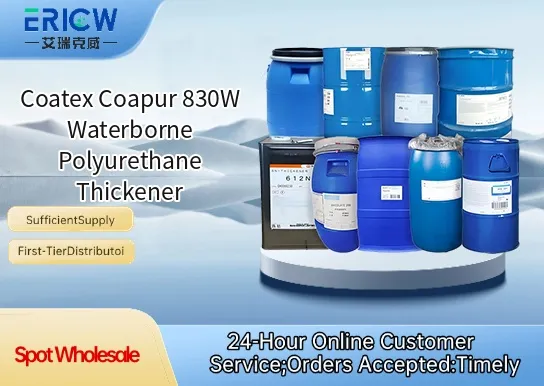
High-efficiency associative thickening with excellent rheology control in low-VOC, waterborne systems.
Outstanding compatibility with acrylic, vinyl-acrylic, and styrene-butadiene emulsions.
Provides superior sag resistance and brush/roller application performance without compromising flow leveling.
Non-ionic, low-foaming formulation ensures stability in preservative-containing formulations.
Enables robust freeze-thaw and shelf-life stability in architectural and industrial coatings.
Interior and exterior architectural wall paints.
Waterborne wood coatings and clear finishes.
Industrial maintenance coatings for metal and concrete substrates.
Water-based primers and undercoats.
Low-VOC decorative and protective coatings for construction applications.
| Chemical Type | Associative polyurethane (HEUR) |
| Product Form | Clear to slightly hazy aqueous dispersion |
| Appearance | Off-white to pale yellow liquid |
| pH (1% aqueous solution) | 6.5 – 7.5 |
| Solids Content (wt%) | 28 – 32% |
| Viscosity (mPa·s, Brookfield RVT, #2 spindle, 20 rpm) | 1,500 – 4,000 |
| Primary Applications | Architectural and industrial waterborne coatings |
| Key Features | Rheology modifier, sag resistance, spray/brush compatibility |
Q1: What type of rheology does Coapur 830W provide in waterborne systems?
A: Coapur 830W is a hydrophobically modified polyurethane (HEUR) thickener that delivers strong pseudoplastic (shear-thinning) rheology, offering excellent flow and leveling at low shear while maintaining good sag resistance and brush/roller holdout at high shear.
Q2: Is Coapur 830W compatible with other common thickeners or additives?
A: Yes — it is generally compatible with associative thickeners such as HASE and HMHEC, and can be used in combination to fine-tune rheological profiles. However, compatibility should always be verified in the final formulation due to potential interactions with surfactants, defoamers, or high levels of electrolytes.
Q3: How should Coapur 830W be incorporated into a waterborne coating formulation?
A: It is typically added during the let-down stage, after pigments and primary binders, under moderate agitation. Pre-dilution with water or a compatible solvent may aid dispersion. Avoid high-shear mixing for extended periods post-addition to preserve its associative network structure.
Q4: Does Coapur 830W affect film clarity or gloss in clear coatings?
A: When properly formulated and dispersed, Coapur 830W generally supports high film clarity and maintains gloss performance in waterborne architectural, wood, and industrial clear coats — unlike some cellulosic thickeners that may induce haze.
Contact With Us:
E-mail: wangxingqiang@ericwchem.com
Have a Questions? Call Us:
Add:
Building A1, Jiete Industrial Park, Huangpu District, Guangzhou City, Guangdong Province, China