English
 Español
 tiếng việt
 русский
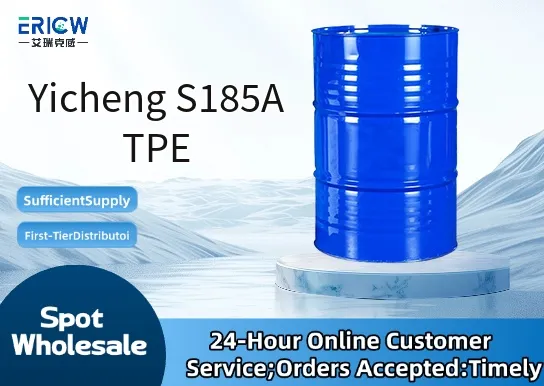
Excellent soft-touch feel with balanced hardness (Shore A 85)
Good processability via injection molding and extrusion
Outstanding elasticity and recovery after deformation
Low-temperature flexibility down to –40 °C
RoHS-compliant and free of phthalates, heavy metals, and halogens
Overmolding for power tool grips and hand-held device housings
Soft-touch automotive interior trim components
Consumer electronics protective cases and accessories
Medical device grips and non-invasive wearable interfaces
Household appliance seals and ergonomic control knobs
| Chemical Type | Thermoplastic Elastomer (TPE-SEBS based) |
| Product Form | Pellets |
| Appearance | Translucent off-white granules |
| Hardness (Shore A) | 85 ± 3 |
| Density (g/cm³) | 0.92–0.94 |
| Melt Flow Rate (230 °C/2.16 kg) | 12–18 g/10 min |
| Tensile Strength (MPa) | 8–10 |
| Elongation at Break (%) | ≥ 450 |
Q1: What is the primary application area for Yicheng S185A TPE?
A: Yicheng S185A TPE is primarily formulated for soft-touch overmolding and functional elastomeric components in consumer electronics, personal care devices, and medical device housings—where consistent melt flow, good adhesion to rigid thermoplastics (e.g., PP, ABS, PC), and skin-friendly tactile properties are required.
Q2: Is Yicheng S185A TPE suitable for injection molding processes?
A: Yes, it is specifically engineered for standard injection molding equipment. It exhibits low viscosity at processing temperatures, minimal thermal degradation during residence time, and excellent mold release characteristics—enabling high-cycle production with stable part dimensions and surface quality.
Q3: How does Yicheng S185A TPE perform in terms of chemical resistance?
A: It offers good resistance to common household chemicals, aliphatic hydrocarbons, and mild aqueous solutions. However, prolonged exposure to strong polar solvents (e.g., ketones, chlorinated hydrocarbons) or oxidizing agents may affect surface integrity and mechanical performance—compatibility testing under end-use conditions is recommended.
Q4: Can Yicheng S185A TPE be colored or compounded with additives?
A: Yes, it is fully compatible with conventional masterbatches and liquid colorants designed for thermoplastic elastomers. It also accepts common functional additives—including UV stabilizers, antistatic agents, and flame retardants—though additive selection should consider potential impact on rheology and final part aesthetics.
Q5: What drying requirements does Yicheng S185A TPE have before processing?
A: While not highly hygroscopic, it is recommended to dry Yicheng S185A TPE at 60–70 °C for 2–4 hours prior to processing to ensure optimal surface finish and mechanical consistency—especially in high-precision or moisture-sensitive applications.
Contact With Us:
E-mail: wangxingqiang@ericwchem.com
Have a Questions? Call Us:
Add:
Building A1, Jiete Industrial Park, Huangpu District, Guangzhou City, Guangdong Province, China