English
 Español
 tiếng việt
 русский
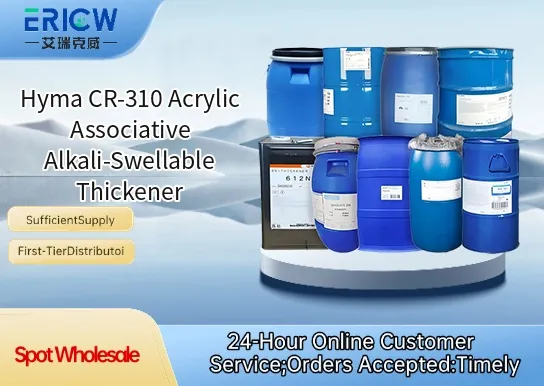
Delivers excellent rheology control with strong pseudoplasticity and high low-shear viscosity.
Provides outstanding sag resistance and anti-settling performance in waterborne formulations.
Offers superior compatibility with anionic surfactants, co-thickeners, and common paint additives.
Enables rapid, stable viscosity development upon pH adjustment to alkaline conditions (pH ≥ 8.5).
Maintains consistent thickening performance across a wide range of temperatures and shear histories.
Architectural interior and exterior latex paints.
Water-based industrial maintenance coatings.
Textile printing pastes and pigment dispersions.
Water-based adhesives and construction sealants.
Carpet backing formulations and nonwoven binders.
| Chemical Type | Acrylic associative alkali-swellable polymer |
| Product Form | Aqueous dispersion |
| Appearance | Opaque white liquid |
| pH (as supplied) | 2.5–4.0 |
| Active Content | 30.0 ± 1.0 wt% |
| Viscosity (Brookfield RVT, Spindle #3, 20 rpm, 25°C) | 500–1500 mPa·s |
| Minimum Effective pH | ≥ 8.5 |
| Storage Stability | ≥ 12 months at 5–30°C in sealed container |
Q1: How does Hyma CR-310 differ from conventional non-associative alkali-swellable thickeners (ASE)?
A: Unlike traditional ASE thickeners, Hyma CR-310 features associative architecture with hydrophobic groups that enable intermolecular network formation in addition to ionic swelling. This results in superior rheology control—especially improved high-shear viscosity recovery, better sag resistance, and enhanced leveling in architectural coatings and industrial finishes.
Q2: What is the recommended pH range for optimal performance of Hyma CR-310?
A: Hyma CR-310 requires alkaline conditions to fully ionize and swell. It performs best in formulations with a stabilized pH of 8.5 or higher, typically achieved using common neutralizing agents such as AMP-95, TEA, or sodium hydroxide. Performance may be significantly reduced below pH 7.5.
Q3: Is Hyma CR-310 compatible with common surfactants and co-thickeners used in waterborne systems?
A: Yes, Hyma CR-310 shows good compatibility with anionic and nonionic surfactants commonly used in architectural and industrial coatings. It can also be effectively combined with cellulosic thickeners or hydrophobically modified ethoxylated urethanes (HEUR) to fine-tune rheological profiles—though pre-testing is recommended to avoid antagonistic interactions.
Q4: How should Hyma CR-310 be incorporated into a formulation to ensure consistent thickening?
A: For optimal dispersion and activation, Hyma CR-310 should be added to the aqueous phase *after* initial neutralization—either as a pre-neutralized paste or by gradual addition under moderate agitation. Direct addition to low-pH or highly ionic phases should be avoided to prevent premature precipitation or uneven thickening.
Contact With Us:
E-mail: wangxingqiang@ericwchem.com
Have a Questions? Call Us:
Add:
Building A1, Jiete Industrial Park, Huangpu District, Guangzhou City, Guangdong Province, China