English
 Español
 tiếng việt
 русский
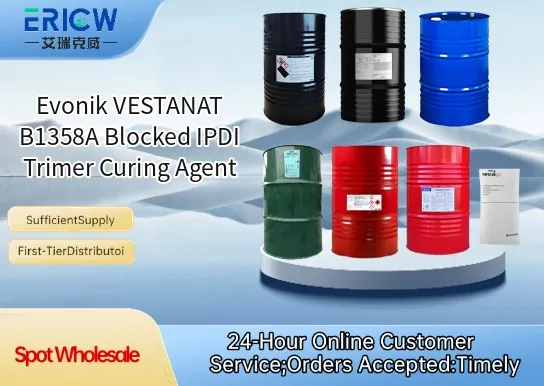
Highly stable blocked isocyanate based on IPDI trimer, offering excellent shelf life and handling safety at ambient temperatures.
Enables low-bake curing (typically 120–140 °C), supporting energy-efficient coating processes without compromising film performance.
Delivers outstanding weather resistance, gloss retention, and UV stability in demanding outdoor applications.
Provides superior chemical resistance and mechanical durability, including hardness, flexibility, and abrasion resistance.
Compatible with a broad range of hydroxyl-functional resins (e.g., acrylics, polyesters, alkyds) for versatile formulation flexibility.
Automotive OEM and refinish clearcoats requiring high gloss, mar resistance, and long-term durability.
Industrial maintenance coatings for metal substrates exposed to harsh environmental or chemical conditions.
Architectural coil coatings where color stability, chalking resistance, and rapid line speed are critical.
Plastic coatings for automotive interior and exterior trim components.
Powder coating hybrid systems seeking enhanced flow, leveling, and edge coverage.
| Chemical Type | Blocked aliphatic isocyanate (IPDI trimer, ε-caprolactam-blocked) |
| Product Form | Liquid |
| Appearance | Pale yellow to light amber, clear liquid |
| NCO Content (unblocked basis) | Approx. 12.5 wt-% |
| Viscosity (25 °C) | Approx. 1,800–2,500 mPa·s |
| Density (20 °C) | Approx. 1.12–1.15 g/cm³ |
| Solvent Content | Non-solvented (100% active) |
| Primary Applications | Two-component (2K) and hybrid thermoset coatings for metal and plastic substrates |
Q1: What is the primary function of VESTANAT B1358A in coating and adhesive formulations?
A: VESTANAT B1358A serves as a thermally activated, blocked polyisocyanate curing agent based on a trimerized isophorone diisocyanate (IPDI) core. It enables one-component (1K) formulations by providing latent reactivity—remaining stable at ambient temperatures but releasing active isocyanate groups upon heating, thereby initiating crosslinking with hydroxyl- or amine-functional resins.
Q2: At what temperature range does the blocking agent dissociate to activate crosslinking?
A: The blocking group in VESTANAT B1358A is designed for thermal deblocking typically starting around 120 °C, with efficient crosslinking achieved between 130 °C and 160 °C. Optimal cure profiles depend on substrate thermal stability, film thickness, and dwell time in the oven.
Q3: Which resin systems is VESTANAT B1358A commonly compatible with?
A: It exhibits good compatibility with hydroxyl-functional acrylics, polyesters, alkyds, and certain polyurethane dispersions. Its low-viscosity liquid form and sterically hindered IPDI trimer structure support formulation stability and reduced gelation risk compared to aromatic or less-hindered aliphatic isocyanates.
Q4: How should VESTANAT B1358A be stored to maintain its stability and shelf life?
A: Store in tightly sealed original containers under dry, cool conditions (ideally below 25 °C) and protected from moisture, direct sunlight, and elevated temperatures. Prolonged exposure to humidity or temperatures above 40 °C may lead to premature deblocking or viscosity increase. Shelf life is typically 12 months from date of manufacture when stored properly.
Q5: Does VESTANAT B1358A require catalysts for efficient curing, and if so, which types are recommended?
A: While VESTANAT B1358A cures effectively without catalysts within its standard thermal window, tertiary amines (e.g., DABCO variants) or metal carboxylates (e.g., dibutyltin dilaurate) may be used to lower the onset temperature or accelerate cure kinetics—particularly in thicker films or heat-sensitive substrates. Catalyst selection and dosage must be evaluated case-by-case to avoid compromising pot life or film appearance.
Contact With Us:
E-mail: wangxingqiang@ericwchem.com
Have a Questions? Call Us:
Add:
Building A1, Jiete Industrial Park, Huangpu District, Guangzhou City, Guangdong Province, China