English
 Español
 tiếng việt
 русский
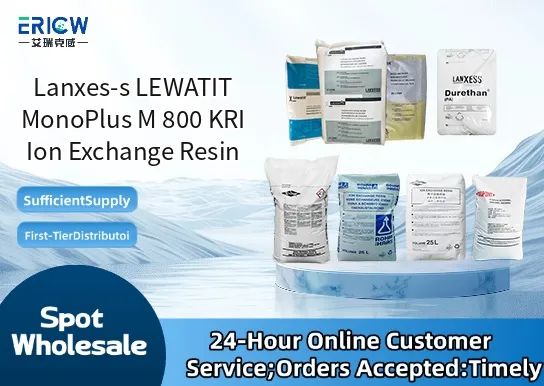
Highly selective monodisperse macroporous strong acid cation exchange resin with sulfonic acid functional groups.
Optimized for potassium removal and hardness reduction in high-purity water treatment systems.
Excellent chemical and physical stability across wide pH (1–14) and temperature ranges (up to 120 °C).
Low operating pressure drop and high hydraulic throughput due to uniform spherical bead morphology (0.45–0.55 mm).
KRI (Kation Removal Improved) designation indicates enhanced selectivity for multivalent cations over sodium and potassium ions.
Ultrapure water (UPW) polishing in semiconductor manufacturing facilities.
Potassium ion removal from pharmaceutical process water and WFI (Water for Injection) loops.
Hardness softening and trace cation scavenging in power plant boiler feedwater pretreatment.
Final cation polishing in laboratory-grade pure water systems and analytical instrument feed lines.
Removal of interfering cations (e.g., Ca²⁺, Mg²⁺, Fe³⁺) prior to anion exchange or EDI units.
| Chemical Type | Strong acid cation exchange resin (sulfonated polystyrene-divinylbenzene) |
| Product Form | Moist, spherical beads |
| Appearance | Opaque amber to light brown beads |
| Mean Particle Size | 0.50 mm (range: 0.45–0.55 mm) |
| Uniformity Coefficient | ≤ 1.3 |
| Functional Group | Sulfonic acid (–SO₃H) |
| Ion Form | H⁺ form (ready-to-use) |
| Maximum Operating Temperature | 120 °C |
Q1: What is the primary functional group and matrix structure of Lanxes-s LEWATIT MonoPlus M 800 KRI?
A: Lanxes-s LEWATIT MonoPlus M 800 KRI is a strongly acidic cation exchange resin based on a highly crosslinked polystyrene-divinylbenzene matrix, functionalized with sulfonic acid groups. Its mono-dispersed bead structure supports high selectivity and consistent hydraulic performance in demanding applications.
Q2: Is this resin suitable for pharmaceutical or food-grade water purification?
A: Yes — Lanxes-s LEWATIT MonoPlus M 800 KRI is manufactured and tested to meet requirements for use in high-purity water systems, including those serving pharmaceutical and food processing industries. It complies with relevant global regulatory expectations for ion exchange resins intended for indirect contact with water used in such applications.
Q3: How does the MonoPlus M 800 KRI differ from standard gel-type cation resins?
A: Unlike conventional gel-type resins, MonoPlus M 800 KRI features a uniform particle size distribution and optimized macroreticular morphology, which enhances kinetic performance, reduces pressure drop, and improves resistance to fouling and osmotic shock — especially during repeated regeneration cycles.
Q4: What regeneration chemicals are typically used with this resin?
A: Standard regeneration employs aqueous sodium chloride (NaCl) solutions. For specialized applications requiring deeper deionization or hardness removal, hydrochloric acid (HCl) may also be applied — always following established operational protocols and compatibility assessments with system materials.
Contact With Us:
E-mail: wangxingqiang@ericwchem.com
Have a Questions? Call Us:
Add:
Building A1, Jiete Industrial Park, Huangpu District, Guangzhou City, Guangdong Province, China