English
 Español
 tiếng việt
 русский
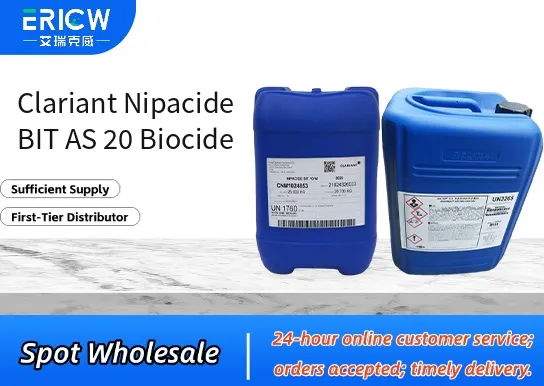
Highly effective broad-spectrum biocide against bacteria, fungi, and algae.
Stable in aqueous systems across a wide pH range (pH 4–10).
Low volatility and excellent compatibility with common industrial additives and surfactants.
Non-oxidizing mode of action ensures minimal impact on system metallurgy and polymer integrity.
Ready-to-use liquid formulation with 20% active concentration of 1,2-benzisothiazolin-3-one (BIT).
Preservation of water-based paints and coatings during storage and application.
Microbial control in metalworking fluids and cutting oils.
Protection of adhesives, sealants, and construction chemicals against spoilage.
Stabilization of pigment dispersions and architectural coatings.
Preservation of industrial cleaning formulations and detergents.
| Chemical Type | 1,2-Benzisothiazolin-3-one (BIT) solution |
| Product Form | Aqueous liquid |
| Appearance | Clear, pale yellow to amber liquid |
| Active Content | 20.0 ± 1.0 wt% BIT |
| pH (1% aqueous solution) | 6.0 – 8.0 |
| Density (20 °C) | 1.05 – 1.10 g/cm³ |
| Solubility | Miscible with water and polar organic solvents |
| Storage Stability | ≥ 24 months at 5–30 °C in original sealed container |
Q1: What is the active ingredient in Nipacide BIT AS 20?
A: The active biocidal component is 1,2-benzisothiazolin-3-one (BIT), supplied as a stable aqueous dispersion formulated with nonionic surfactants to ensure compatibility and ease of handling in water-based systems.
Q2: In which types of industrial formulations is Nipacide BIT AS 20 commonly used?
A: It is widely applied in water-based paints and coatings, adhesives, sealants, construction chemicals, metalworking fluids, and household and institutional cleaning products where broad-spectrum preservation against bacteria, yeasts, and molds is required.
Q3: How should Nipacide BIT AS 20 be incorporated into a formulation?
A: It is typically added during the final stage of manufacturing, after pH adjustment and cooling, to minimize thermal degradation. Good agitation ensures uniform dispersion, and compatibility testing is recommended for each specific formulation matrix.
Q4: Is Nipacide BIT AS 20 compatible with common preservatives or antimicrobials?
A: It can often be used synergistically with other preservatives such as isothiazolinones, formaldehyde donors, or organic acids—however, compatibility and efficacy must be validated case-by-case, as interactions may affect stability or performance.
Q5: What safety and handling precautions should be observed?
A: As with all biocidal agents, appropriate personal protective equipment (PPE) such as gloves and eye protection should be worn during handling. Avoid inhalation of mists or prolonged skin contact. Refer to the Safety Data Sheet (SDS) for detailed toxicological and first-aid information.
Contact With Us:
E-mail: wangxingqiang@ericwchem.com
Have a Questions? Call Us:
Add:
Building A1, Jiete Industrial Park, Huangpu District, Guangzhou City, Guangdong Province, China