English
 Español
 tiếng việt
 русский
High thermal stability up to 800 °C, suitable for high-temperature ceramic and enamel applications.
Excellent lightfastness and weather resistance, maintaining color integrity under prolonged UV exposure.
Non-toxic composition compliant with global regulatory standards including EN 71-3 and RoHS.
Strong tinting strength and consistent batch-to-batch color reproducibility.
Chemically inert in alkaline and mildly acidic environments, ensuring formulation stability in diverse binder systems.
Ceramic glazes and underglaze decorations for tableware and architectural tiles.
High-performance enamel coatings for household appliances and industrial metal substrates.
Colorants in refractory materials and heat-resistant mortars.
Pigmentation of specialty glass frits and low-melting-point glass compositions.
Functional fillers in flame-retardant polymer composites requiring thermal stability.
| Chemical Type | Complex mixed-metal oxide (Fe–Cr–Al spinel-based) |
| Product Form | Fine free-flowing powder |
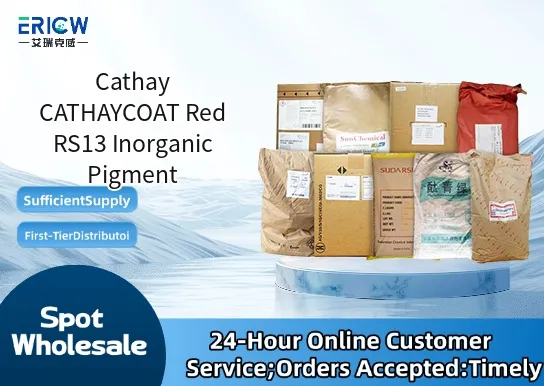
| Appearance | Brilliant ruby-red granular powder |
| Primary Applications | Ceramics, enamels, refractories, specialty glass |
| Key Features | Thermal stability, UV resistance, non-volatility, heavy-metal-free |
| Particle Size (D50) | 1.2–1.8 µm |
| Bulk Density | 2.1–2.4 g/cm³ |
| pH (10% aqueous slurry) | 6.5–7.5 |
Q1: What is the primary chemical composition of Cathay CATHAYCOAT Red RS13?
A: Cathay CATHAYCOAT Red RS13 is a high-performance inorganic red pigment based on a stabilized iron oxide–chromium oxide spinel structure, engineered for thermal and chemical stability in demanding coating applications.
Q2: Is this pigment suitable for use in high-temperature curing systems, such as powder coatings or coil coatings?
A: Yes — RS13 is specifically formulated to retain color integrity and dispersion stability under elevated processing temperatures, making it well-suited for powder coatings, coil coatings, and other thermally cured industrial systems.
Q3: How does RS13 compare to organic red pigments in terms of weather resistance and UV stability?
A: As an inorganic pigment, RS13 offers significantly superior resistance to UV degradation, chalking, and fading compared to most organic reds—especially in exterior architectural and automotive OEM applications where long-term color retention is critical.
Q4: What types of binder systems is RS13 compatible with?
A: RS13 demonstrates broad compatibility with common industrial resin systems, including epoxy, polyester, acrylic, alkyd, and polyurethane binders—both solvent-based and water-reducible formulations.
Q5: What is the typical dosage range for achieving optimal opacity and chroma in industrial coatings?
A: Dosage depends on formulation requirements, but RS13 is typically used at low concentrations—generally ranging from 0.1% to 2% by weight—to deliver strong tinting strength and excellent hiding power without compromising film integrity.
Contact With Us:
E-mail: wangxingqiang@ericwchem.com
Have a Questions? Call Us:
Add:
Building A1, Jiete Industrial Park, Huangpu District, Guangzhou City, Guangdong Province, China