English
 Español
 tiếng việt
 русский
Broad-spectrum antimicrobial activity against bacteria, yeasts, and fungi.
Stable across a wide pH range (pH 4–10), maintaining efficacy in diverse formulations.
Low volatility and minimal odor, supporting safe handling and consumer acceptance.
Compatible with common surfactants, thickeners, and preservative systems in water-based products.
Non-oxidizing chemistry, reducing risk of material corrosion and product degradation.
Preservation of liquid household and industrial cleaners.
Microbial control in car wash and engine degreaser concentrates.
Stabilization of water-based metalworking fluids.
Protection of architectural coatings and latex paints during storage.
Preservation of adhesives, sealants, and construction chemical formulations.
| Chemical Type | Glyoxal-based biocide |
| Product Form | Aqueous solution |
| Appearance | Clear, colorless to pale yellow liquid |
| pH (1% aqueous solution) | 3.0–5.0 |
| Density (20 °C) | 1.08–1.12 g/cm³ |
| Solubility | Miscible with water in all proportions |
| Primary Applications | Preservation of water-based industrial and consumer products |
| Key Features | Non-formaldehyde, low-toxicity, broad-spectrum efficacy |
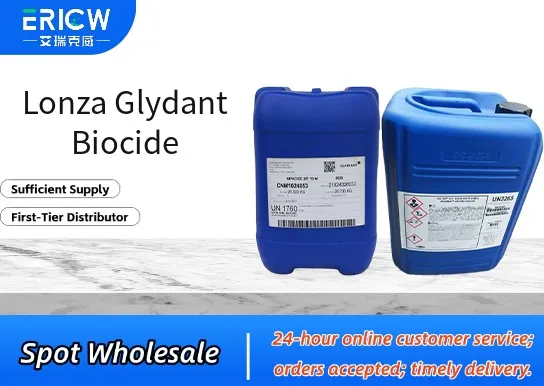
Q1: What is Lonza Glydant Biocide and what types of microorganisms does it control?
A: Lonza Glydant Biocide is a broad-spectrum preservative based on glutaraldehyde and DMDM hydantoin. It is designed to provide effective protection against bacteria, yeasts, and molds in water-based industrial formulations, particularly where long-term microbial stability is required.
Q2: In which types of formulations is Glydant Biocide typically used?
A: It is commonly incorporated into water-based paints and coatings, metalworking fluids, adhesives, construction chemicals, and cleaning solutions—especially those with moderate pH ranges and low levels of reducing agents or strong nucleophiles that could compromise efficacy.
Q3: How should Glydant Biocide be added to a formulation?
A: It is recommended to add Glydant Biocide during the cool-down phase, after high-temperature processing steps, and preferably near the end of manufacturing to minimize degradation. Pre-dilution with water or compatible solvent may improve dispersion, especially in viscous systems.
Q4: Is Glydant Biocide compatible with common thickeners, surfactants, and other preservatives?
A: Glydant Biocide generally shows good compatibility with nonionic and anionic surfactants, associative and cellulosic thickeners, and many common co-biocides—though compatibility should always be verified experimentally in the final formulation due to potential interactions with sulfites, strong reductants, or highly amine-rich systems.
Q5: What safety and handling considerations apply to Glydant Biocide?
A: As with all glutaraldehyde-containing products, appropriate personal protective equipment—including gloves, eye protection, and adequate ventilation—is recommended during handling. Users should consult the Safety Data Sheet for detailed toxicological information, exposure controls, and first-aid measures.
Contact With Us:
E-mail: wangxingqiang@ericwchem.com
Have a Questions? Call Us:
Add:
Building A1, Jiete Industrial Park, Huangpu District, Guangzhou City, Guangdong Province, China