English
 Español
 tiếng việt
 русский
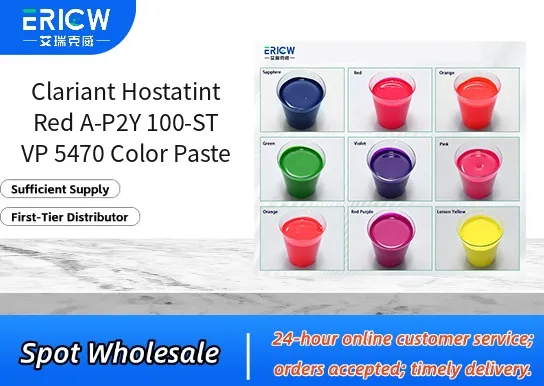
High chroma, clean red shade with excellent lightfastness for demanding aesthetic applications.
Optimized rheology for easy dispersion and uniform distribution in water-based systems.
Low migration and high thermal stability, supporting processing up to 180 °C.
Compliant with major global regulatory frameworks including EU REACH and US FDA 21 CFR for indirect food contact applications.
Free of heavy metals, formaldehyde, and APEOs—designed for sustainable manufacturing.
Water-based inks for flexible packaging and label printing.
Decorative laminates and HPL (high-pressure laminates) for interior surfaces.
Coatings for architectural wood finishes and furniture components.
Plastic coloration of PVC, ABS, and PS for consumer electronics housings.
Textile printing pastes for polyester and polyester-cotton blends.
| Chemical Type | Azo pigment dispersion |
| Product Form | Concentrated aqueous color paste |
| Appearance | Viscous, homogeneous red paste |
| Primary Applications | Water-based inks, coatings, plastics, and textile printing |
| Key Features | High tinctorial strength, low viscosity, excellent storage stability |
| Benefits | Reduced dosing, improved batch consistency, simplified formulation |
| pH Value (25 °C) | 7.5–8.5 |
| Storage Temperature | 5–30 °C; protect from freezing |
Q1: What types of polymer systems is this color paste compatible with?
A: Hostatint Red A-P2Y 100-ST VP 5470 is specifically formulated for use in polyolefin-based systems, including PP and HDPE, and demonstrates good compatibility in certain engineering thermoplastics. It is not recommended for highly polar or hydrophilic matrices such as PET or PA without prior compatibility testing.
Q2: How should this color paste be incorporated into the polymer melt?
A: The paste is designed for direct addition during compounding or injection molding processes. It can be metered using standard gravimetric or volumetric dosing equipment. Pre-mixing with a small portion of base resin prior to main extrusion is recommended to ensure uniform dispersion.
Q3: Is this product suitable for food-contact applications?
A: This grade is intended for non-food-contact applications unless explicitly certified for such use in your target market. Regulatory compliance must be verified case-by-case with local authorities and end-use specifications — Clariant does not provide blanket food-contact approval for this formulation.
Q4: What is the typical dosage range for achieving strong red shades in polypropylene?
A: Dosage depends on the desired shade intensity and base resin characteristics, but typical usage generally ranges from 0.1% to 2% by weight. Stronger chroma is achievable at the higher end, while pastel tones may require lower concentrations and careful dispersion control.
Contact With Us:
E-mail: wangxingqiang@ericwchem.com
Have a Questions? Call Us:
Add:
Building A1, Jiete Industrial Park, Huangpu District, Guangzhou City, Guangdong Province, China