English
 Español
 tiếng việt
 русский
Low-VOC, environmentally compliant formulation meeting global regulatory standards for waterborne coatings.
Excellent film hardness and abrasion resistance after ambient or mild thermal cure.
Superior adhesion to diverse substrates including plastics, metals, and treated wood.
Good hydrolytic stability and freeze-thaw resistance for reliable storage and handling.
Easy integration with acrylic dispersions and crosslinkers for hybrid coating systems.
High-performance waterborne topcoats for automotive interior trim and instrument panels.
Protective clearcoats for rigid plastic packaging and consumer electronics housings.
Decorative and functional coatings for metal furniture and architectural metal components.
Flexible yet durable finishes for coated textiles and synthetic leather substrates.
| Chemical Type | Anionic aliphatic polyurethane dispersion |
| Product Form | Opaque white to off-white liquid |
| Appearance | Homogeneous aqueous dispersion |
| Solids Content (wt%) | 30.0 ± 1.0% |
| pH (at 25°C) | 7.8 – 8.5 |
| Viscosity (mPa·s, Brookfield RVT, #2 spindle, 20 rpm) | 1,200 – 2,500 |
| Particle Size (D50, nm) | 80 – 120 |
| Minimum Film Formation Temperature (MFFT) | 15°C |
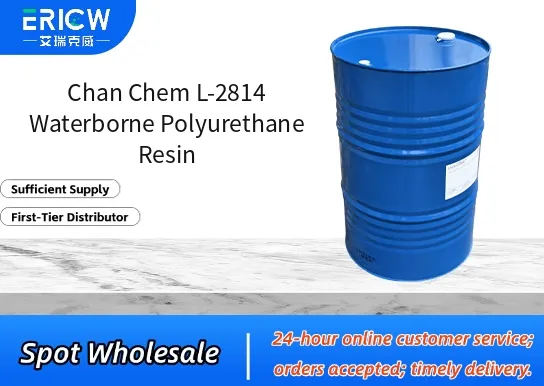
Q1: What are the primary application areas for Chan Chem L-2814?
A: Chan Chem L-2814 is widely used in waterborne industrial coatings, including wood finishes, plastic coatings, and flexible packaging laminates where high gloss, abrasion resistance, and substrate adhesion are required. It is also suitable for textile and leather finishing applications demanding soft hand feel and wash-fastness.
Q2: How does L-2814 perform in terms of film formation and curing at ambient conditions?
A: L-2814 forms continuous, cohesive films at room temperature with good coalescence behavior. While it achieves functional performance without thermal curing, elevated temperatures (e.g., 60–80°C) or extended drying time can enhance crosslink density, hardness, and chemical resistance in final films.
Q3: Is L-2814 compatible with common waterborne acrylic dispersions and other additives?
A: Yes, L-2814 demonstrates broad compatibility with anionic and non-ionic waterborne acrylics, as well as standard formulation additives such as defoamers, wetting agents, and rheology modifiers. Compatibility testing under actual formulation conditions is recommended to confirm stability and performance synergy.
Q4: What viscosity range should be expected, and how does it affect handling and application?
A: L-2814 is supplied as a low-to-medium viscosity dispersion, enabling easy incorporation into aqueous systems without high-shear pre-mixing. Its rheological profile supports conventional application methods such as spray, roll-coating, and dip-coating, with minimal adjustment needed for most industrial equipment.
Q5: Does L-2814 require external crosslinkers for optimal performance?
A: L-2814 offers self-crosslinking capability through its built-in reactive functionality, delivering adequate performance in many single-component systems. However, for enhanced chemical resistance, hardness, or heat stability, optional addition of aziridine or carbodiimide crosslinkers may be considered based on end-use requirements.
Contact With Us:
E-mail: wangxingqiang@ericwchem.com
Have a Questions? Call Us:
Add:
Building A1, Jiete Industrial Park, Huangpu District, Guangzhou City, Guangdong Province, China