English
 Español
 tiếng việt
 русский
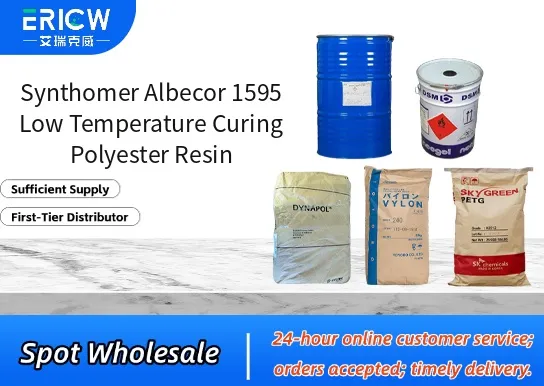
Enables full cure at ambient to moderately elevated temperatures (as low as 15–25°C with appropriate catalyst), reducing energy consumption and thermal stress on substrates.
Delivers excellent chemical resistance, particularly to water, alkalis, and mild acids, supporting durable performance in demanding environments.
Offers good flexibility and impact resistance post-cure, enhancing substrate adhesion and crack resistance on composite and coated surfaces.
Formulated for low viscosity and high reactivity with standard peroxide initiators (e.g., MEKP), ensuring ease of processing via spray, dip, or roll-coating.
Provides low styrene emission profile compared to conventional orthophthalic polyesters, contributing to improved workplace safety and regulatory compliance.
Fiberglass-reinforced plastic (FRP) components for transportation interiors where heat-sensitive substrates limit oven curing.
Marine deck coatings and non-skid surfacing systems requiring rapid turnaround and low-temperature field application.
Architectural precast concrete cladding and façade panels needing low-exotherm cure to prevent surface defects.
Industrial maintenance coatings for pipelines, tanks, and structural steel in ambient-temperature retrofit projects.
Lightweight composite enclosures for electrical and telecom equipment manufactured without thermal post-cure.
| Chemical Type | Unsaturated orthophthalic polyester resin |
| Product Form | Liquid, ready-to-use |
| Appearance | Clear to pale yellow viscous liquid |
| Viscosity (25°C, mPa·s) | 800–1,200 |
| Solids Content (% w/w) | 100 (solvent-free) |
| Acid Value (mg KOH/g) | 12–18 |
| Reactivity Profile | Medium–high (compatible with low-temp peroxide catalysts) |
| Primary Applications | Low-temperature cured FRP, protective coatings, architectural composites |
Q1: What is the primary advantage of using Albecor 1595 over conventional polyester resins?
A: Albecor 1595 is specifically engineered for low-temperature curing—enabling full crosslinking at temperatures as low as 100–130 °C—making it ideal for heat-sensitive substrates such as certain plastics, coated metals, or pre-assembled components where high-temperature processing is impractical or damaging.
Q2: Is Albecor 1595 compatible with standard polyester resin catalysts and accelerators?
A: Yes, Albecor 1595 is formulated to work effectively with common peroxide initiators (e.g., MEKP) and cobalt-based accelerators. However, optimal catalyst selection and dosage depend on the target cure profile and substrate requirements, and should be validated through small-scale trials.
Q3: Can Albecor 1595 be used in coatings requiring flexibility and impact resistance?
A: Yes—the molecular design of Albecor 1595 delivers a balanced combination of hardness and toughness after cure, supporting applications where resistance to mechanical stress, bending, or thermal cycling is important, such as protective coatings for industrial appliances or automotive trim components.
Q4: How does Albecor 1595 perform in terms of chemical resistance after low-temperature cure?
A: When fully cured under recommended conditions, Albecor 1595 exhibits good resistance to common solvents, weak acids, and alkaline cleaners—comparable to many standard polyester systems—though extended exposure to aggressive chemicals may require evaluation in the specific end-use environment.
Contact With Us:
E-mail: wangxingqiang@ericwchem.com
Have a Questions? Call Us:
Add:
Building A1, Jiete Industrial Park, Huangpu District, Guangzhou City, Guangdong Province, China