English
 Español
 tiếng việt
 русский
Excellent water resistance and chemical resistance after film formation.
Enhanced mechanical strength and abrasion resistance due to polyurethane modification.
Low VOC content, compliant with stringent environmental regulations for waterborne coatings.
Good compatibility with common waterborne acrylics, melamines, and crosslinkers.
Smooth film formation with high gloss retention and excellent leveling properties.
Industrial maintenance coatings for metal structures and equipment.
Waterborne wood finishes for interior furniture and cabinetry.
Architectural coatings for interior walls and trim requiring durable, low-odor films.
Coatings for light-duty agricultural and construction machinery.
Base resin for high-performance waterborne can coatings and coil coatings.
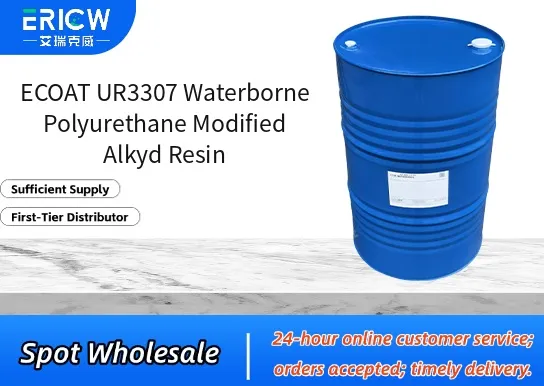
| Chemical Type | Waterborne polyurethane-modified alkyd resin |
| Product Form | Aqueous dispersion |
| Appearance | Opaque white to off-white liquid |
| pH (10% aqueous solution) | 7.5 – 8.5 |
| Solids Content (wt%) | 45 ± 2% |
| Viscosity (Brookfield RVT, #3 spindle, 20 rpm, 25°C) | 1,200 – 2,000 cP |
| Minimum Film Formation Temperature (MFFT) | 12°C |
| Primary Applications | Waterborne industrial and architectural topcoats |
Q1: What are the primary benefits of using ECOAT UR3307 compared to conventional solvent-based alkyds?
A: ECOAT UR3307 offers significantly reduced VOC content while retaining the excellent film formation, gloss retention, and substrate adhesion typical of high-performance alkyds. The polyurethane modification enhances mechanical durability, chemical resistance, and flexibility—making it especially suitable for demanding waterborne industrial coatings where performance parity with solvent systems is required.
Q2: Can ECOAT UR3307 be used in direct-to-metal (DTM) formulations?
A: Yes, ECOAT UR3307 is commonly incorporated into DTM waterborne coatings for mild to moderate corrosion environments. Its balanced hydrophobicity and crosslink density support good wet adhesion and early water resistance on ferrous and non-ferrous substrates—though optimal performance requires careful formulation with compatible corrosion inhibitors and rheology modifiers.
Q3: How does ECOAT UR3307 behave during ambient or forced-dry curing?
A: ECOAT UR3307 exhibits efficient coalescence and oxidative crosslinking at ambient temperatures, with noticeable improvement in hardness and solvent resistance within 24–48 hours. Forced drying at moderate temperatures (e.g., 60–80°C) accelerates film development and enhances final crosslink density, particularly when formulated with appropriate driers or co-resins.
Q4: Is ECOAT UR3307 compatible with common waterborne acrylic or epoxy dispersions?
A: Yes, ECOAT UR3307 demonstrates broad compatibility with many anionic and non-ionic waterborne acrylics, as well as amine-functionalized epoxy dispersions. Compatibility should always be verified empirically in the target formulation due to sensitivity to pH, ionic strength, and surfactant systems—but phase stability and film homogeneity are typically achieved without extensive adjustment.
Contact With Us:
E-mail: wangxingqiang@ericwchem.com
Have a Questions? Call Us:
Add:
Building A1, Jiete Industrial Park, Huangpu District, Guangzhou City, Guangdong Province, China