English
 Español
 tiếng việt
 русский
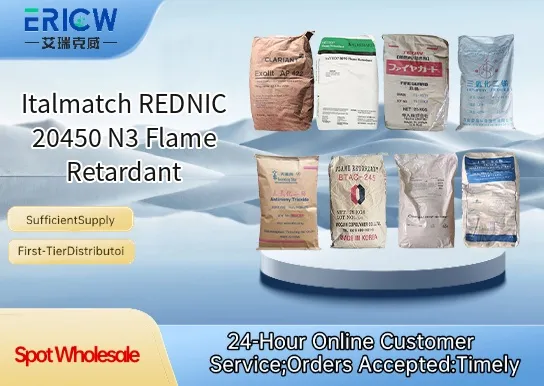
Halogen-free, phosphorus-nitrogen synergistic flame retardant system for enhanced fire safety compliance.
Low smoke and low toxicity profile, meeting stringent environmental and occupational health requirements.
Excellent thermal stability up to 280 °C, suitable for high-temperature polymer processing.
Good compatibility and dispersion in polyamide (PA6, PA66) and polypropylene (PP) matrices.
Non-migrating formulation ensures long-term flame retardancy retention without surface blooming.
Electrical and electronic enclosures requiring UL94 V-0 rating at thin wall sections.
Automotive interior components including dashboards, trim parts, and connector housings.
Wire and cable jacketing materials for low-smoke zero-halogen (LSZH) applications.
Industrial machinery housings exposed to elevated ambient temperatures and fire risk.
| Chemical Type | Organophosphorus-nitrogen compound |
| Product Form | Fine white to off-white free-flowing powder |
| Appearance | Homogeneous granular powder |
| Primary Applications | Polyamide 6, Polyamide 66, Polypropylene |
| Key Features | Halogen-free, RoHS-compliant, REACH registered |
| Benefits | Enables UL94 V-0 @ 1.6 mm in PA6/66; reduces afterglow and heat release rate |
| Density (g/cm³) | 1.5–1.7 (at 23 °C) |
| Moisture Content (wt%) | ≤ 0.5% |
Q1: What is the primary mechanism of flame retardancy for REDNIC 20450 N3?
A: REDNIC 20450 N3 functions primarily through an intumescent mechanism — it promotes the formation of a protective, carbon-rich char layer upon exposure to heat, which insulates the underlying polymer and impedes heat transfer, fuel release, and oxygen diffusion.
Q2: Is REDNIC 20450 N3 suitable for halogen-free flame-retarded polyolefin compounds?
A: Yes — it is specifically engineered for halogen-free flame retardancy in polyolefins such as PP and PE, offering good compatibility and processability without compromising mechanical properties or color stability.
Q3: How does REDNIC 20450 N3 perform under typical compounding conditions (e.g., twin-screw extrusion)?
A: It demonstrates excellent thermal stability during melt processing, with minimal volatilization or degradation up to approximately 250 °C, making it well-suited for standard extrusion and injection molding processes used in compound production.
Q4: Can REDNIC 20450 N3 be used in combination with other flame retardants or synergists?
A: Yes — it is often combined with synergistic additives such as melamine derivatives or metal phosphinates to enhance char yield and improve fire performance, particularly in demanding applications requiring UL 94 V-0 or LOI >30%.
Q5: What are the recommended handling and storage conditions for this product?
A: Store in a cool, dry place in original sealed packaging to prevent moisture absorption; handle using standard industrial hygiene practices — avoid inhalation of dust and prolonged skin contact, and refer to the Safety Data Sheet for detailed occupational guidance.
Contact With Us:
E-mail: wangxingqiang@ericwchem.com
Have a Questions? Call Us:
Add:
Building A1, Jiete Industrial Park, Huangpu District, Guangzhou City, Guangdong Province, China