English
 Español
 tiếng việt
 русский
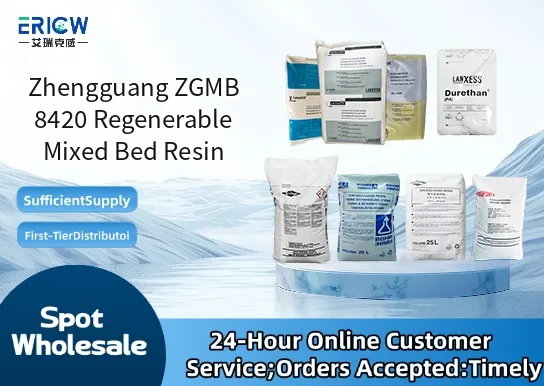
Highly regenerable cation/anion resin blend enabling multiple service-regeneration cycles without significant capacity loss.
Optimized particle size distribution for uniform flow dynamics, low pressure drop, and reduced channeling in mixed bed vessels.
Excellent chemical stability in both acidic and alkaline regeneration environments (HCl/NaOH), ensuring long operational life.
Low total organic carbon (TOC) extractables, meeting stringent purity requirements for ultrapure water production.
Pre-mixed and pre-balanced ratio of strong acid cation (SAC) and strong base anion (SBA) resins for immediate on-stream performance.
Final polishing stage in power plant boiler feedwater treatment systems.
Ultrapure water (UPW) generation for semiconductor manufacturing facilities.
Pharmaceutical-grade purified water (PW) and water for injection (WFI) polishing loops.
Electronics industry rinse water purification requiring <0.1 µS/cm conductivity.
Critical laboratory and research facility water systems demanding consistent resistivity >18.0 MΩ·cm.
| Chemical Type | Pre-mixed strong acid cation (SAC) + strong base anion (SBA) gel-type resins |
| Product Form | Wet, ready-to-use spherical beads in aqueous suspension |
| Appearance | Uniform amber (cation) and white (anion) beads; no visible fines or agglomerates |
| Primary Applications | High-purity water polishing, UPW final treatment, critical industrial demineralization |
| Key Features | Regenerable, low TOC leachables, narrow particle size distribution (0.3–1.2 mm) |
| Benefits | Reduced downtime, predictable regeneration efficiency, compliance with ASTM D1193 Type I & ISO 3696 Grade 1 |
| Storage Conditions | 5–40 °C; protect from freezing and direct sunlight |
| Regeneration Protocol | Counter-current HCl (4–5%) followed by NaOH (4–5%); full separation not required |
Q1: What is the primary application of ZGMB 8420 in water purification systems?
A: ZGMB 8420 is specifically engineered for high-purity water production in mixed bed deionization units, commonly used in power generation, pharmaceutical water systems, and electronics-grade ultrapure water loops where consistent resistivity above 15 MΩ·cm is required.
Q2: How does ZGMB 8420 differ from conventional single-use mixed bed resins?
A: Unlike disposable resins, ZGMB 8420 is designed for multiple on-site regeneration cycles using standard acid and caustic solutions, significantly reducing operational waste and long-term consumables cost while maintaining stable ion exchange capacity across repeated service-regeneration cycles.
Q3: What are the recommended operating conditions to maximize resin longevity?
A: Optimal performance is achieved with feed water having low organic load and suspended solids (< 0.1 ppm TOC, < 0.1 NTU), inlet temperature between 5–40°C, and service flow rates aligned with manufacturer-specified design guidelines to minimize channeling and pressure drop rise.
Q4: Can ZGMB 8420 be blended or layered with other resins in a single vessel?
A: ZGMB 8420 is formulated as a pre-mixed, uniformly graded cation/anion resin blend optimized for balanced regeneration efficiency and minimal cross-contamination risk; intentional blending with non-compatible resins is not recommended without prior compatibility testing and hydraulic profiling.
Contact With Us:
E-mail: wangxingqiang@ericwchem.com
Have a Questions? Call Us:
Add:
Building A1, Jiete Industrial Park, Huangpu District, Guangzhou City, Guangdong Province, China