English
 Español
 tiếng việt
 русский
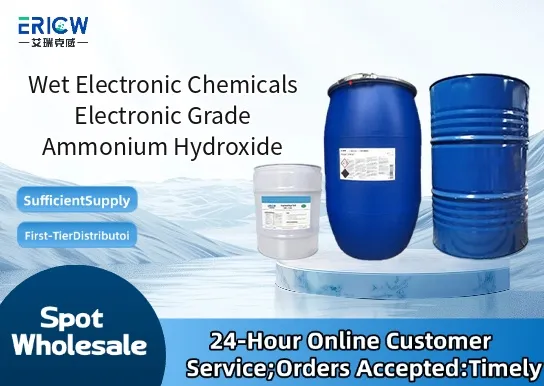
Ultra-low metallic impurities (≤10 ppt for Na, K, Ca, Fe, Cu, Ni, Zn, Cr, Al)
Controlled particle count (<1 particle/mL @ ≥0.1 µm, measured per SEMI F57)
Strictly controlled anionic contaminants (Cl⁻, SO₄²⁻, NO₃⁻ ≤ 50 ppt each)
Manufactured and packaged in ISO Class 4 (Class 10) cleanroom environments
Available in high-purity fluoropolymer-lined containers (e.g., FEP, PFA) to prevent leaching
Photoresist stripping in advanced logic and memory device fabrication
Pre-gate oxide cleaning prior to ALD or CVD deposition
Removal of organic residues after plasma etch processes
Surface conditioning of silicon wafers before epitaxial growth
Cleaning of photomask blanks and reticles in mask shops
| Chemical Type | Aqueous ammonium hydroxide solution (NH₄OH) |
| Product Form | Liquid, ready-to-use |
| Appearance | Clear, colorless liquid without visible particles or haze |
| Concentration Range | 28–30 wt% NH₃ in H₂O (standard grade); custom concentrations available |
| Primary Applications | Wafer cleaning, photoresist removal, surface preparation in semiconductor manufacturing |
| Key Features | Low volatility residue, non-oxidizing, compatible with Si, SiO₂, and low-k dielectrics |
| Benefits | Minimizes pattern collapse, reduces metal contamination risk, enables sub-5nm node process compatibility |
| Regulatory Compliance | REACH compliant; SDS available; meets SEMI C1–C12 and SEMI F57 standards |
| Common Compatible Systems | Suitability |
| Single-wafer spin-rinse-dry (SRD) tools (e.g., Tokyo Electron, Lam Research) | Highly Recommended – Optimized for uniform distribution and low residual film formation |
| Batch immersion systems (e.g., SCREEN, DNS) | Recommended – Requires precise temperature and concentration control for reproducible results |
| Automated chemical delivery systems (e.g., Entegris ChemTainer®) | Highly Recommended – Compatible with FEP/PFA fluid paths and ultra-low particle filtration |
| On-tool dispense modules with integrated DI water dilution | Suitable – Supports inline dilution to 0.1–5.0 wt% for precision cleaning applications |
Q1: What is the CAS Number for Electronic Grade Ammonium Hydroxide?
A: The CAS Number is 1336-21-6 (for aqueous NH₄OH); product lot-specific certificates of analysis include traceability to raw material suppliers.
Q2: How does its usage differ from technical-grade ammonium hydroxide in semiconductor processes?
A: Electronic grade eliminates >99.9% of ionic and particulate contaminants present in technical grades, preventing gate oxide defects, junction leakage, and yield loss—especially critical below 28 nm nodes.
Q3: Is it compliant with USP/EP pharmaceutical standards or food-contact regulations?
A: No—it is not intended for pharmaceutical or food applications. It meets semiconductor-specific purity standards (SEMI, JEDEC), not USP/EP or FDA 21 CFR requirements.
Q4: Does it cause extractables or leachables when in contact with fluoropolymer piping?
A: When handled in certified FEP/PFA systems at recommended temperatures (<40 °C), extractables are below detection limits per GC-MS and ICP-MS testing per SEMI F63.
Contact With Us:
E-mail: wangxingqiang@ericwchem.com
Have a Questions? Call Us:
Add:
Building A1, Jiete Industrial Park, Huangpu District, Guangzhou City, Guangdong Province, China