English
 Español
 tiếng việt
 русский
Highly selective methanol synthesis catalyst optimized for low-pressure operation.
Enhanced thermal stability and resistance to sintering under prolonged industrial cycling.
Robust performance in feed gases containing trace CO₂ and varying H₂/CO/CO₂ ratios.
Low attrition rate ensures extended catalyst lifetime and reduced reactor downtime.
Designed for seamless integration into existing low-to-mid-capacity methanol plants.
Single-pass low-pressure methanol synthesis from syngas.
Small- to medium-scale green methanol production using renewable hydrogen and captured CO₂.
Modular and skid-mounted methanol units for distributed chemical manufacturing.
Upgrading legacy methanol plants requiring improved conversion efficiency and lower energy input.
On-purpose methanol supply for fuel blending and derivative production (e.g., DME, olefins).
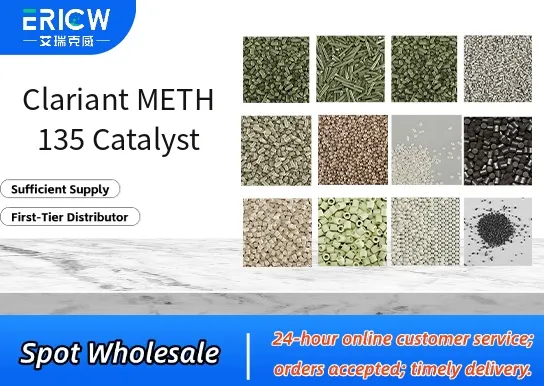
| Chemical Type | Copper–zinc oxide–alumina (Cu/ZnO/Al₂O₃) based heterogeneous catalyst |
| Product Form | Extrudates (cylindrical pellets) |
| Appearance | Gray to dark gray free-flowing granules |
| Primary Applications | Methanol synthesis from syngas (H₂/CO/CO₂ mixtures) |
| Key Features | Low-temperature activity, high selectivity, sulfur-tolerant formulation |
| Operating Temperature Range | 200–280 °C |
| Recommended Pressure Range | 50–100 bar |
| Storage Condition | Sealed packaging; store in dry, cool, well-ventilated area away from moisture and oxidizing agents |
Q1: What is the primary function of METH 135 in polyurethane systems?
A: METH 135 is a highly selective tertiary amine catalyst designed to promote the urethane reaction (isocyanate–polyol coupling) while minimizing side reactions such as trimerization or hydrolysis, enabling better control over gel time and foam rise profile in flexible slabstock and molded foam applications.
Q2: How does METH 135 compare to traditional amine catalysts like DABCO® 33-LV or TEDA?
A: Compared to conventional aliphatic amines, METH 135 offers enhanced latency and improved compatibility with water-blown systems, resulting in reduced odor, lower volatility, and more consistent reactivity across varying ambient and formulation conditions—without requiring co-catalysts for balanced gelling and blowing.
Q3: Is METH 135 suitable for low-emission or automotive-grade foam formulations?
A: Yes—METH 135 is formulated to support low-VOC and low-odor foam production, making it well-suited for interior automotive applications where stringent emissions testing (e.g., VDA 278) and long-term cabin air quality requirements apply.
Q4: What are the recommended handling and storage conditions for METH 135?
A: METH 135 should be stored in its original sealed container under dry, cool conditions (below 30 °C), protected from moisture and direct sunlight. It is hygroscopic and may absorb CO₂ from air over time, so containers should be tightly closed after each use to maintain catalytic activity and shelf life.
Contact With Us:
E-mail: wangxingqiang@ericwchem.com
Have a Questions? Call Us:
Add:
Building A1, Jiete Industrial Park, Huangpu District, Guangzhou City, Guangdong Province, China