English
 Español
 tiếng việt
 русский
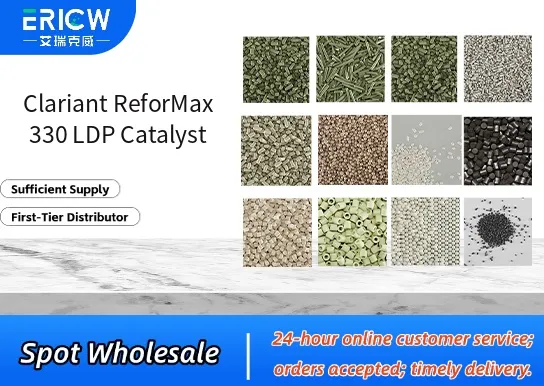
Highly selective low-deactivation platinum-based catalyst for hydroprocessing of light distillates.
Optimized metal dispersion and tailored acidity to maximize naphtha reformate yield and octane number.
Robust resistance to sulfur and nitrogen poisoning under continuous LDP (Low-Deposition Process) operating conditions.
Engineered for extended cycle length and stable performance in semi-regenerative and cyclic reformers.
Consistent batch-to-batch reproducibility supported by Clariant’s ISO 9001-certified manufacturing.
Continuous catalytic reforming (CCR) units processing naphtha feedstocks with moderate impurity levels.
Semi-regenerative reformers requiring high stability and predictable deactivation behavior.
Refineries upgrading straight-run or hydrotreated naphthas to high-octane reformate for gasoline blending.
Integrated refining complexes seeking improved hydrogen yield and reduced coke formation.
| Chemical Type | Platinum–Rhenium–Tin on alumina support with proprietary promoter system |
| Product Form | Extruded cylindrical pellets (1.6 mm diameter, 3–5 mm length) |
| Appearance | Gray to dark gray free-flowing granular solid |
| Primary Applications | Catalytic reforming of light naphtha feedstocks (C6–C10) |
| Key Features | Low-deposition design, enhanced metal sintering resistance, optimized acid/metal balance |
| Benefits | Higher liquid yield, improved C5+ selectivity, reduced hydrogen consumption, longer run lengths |
| Storage Requirement | Store in dry, well-ventilated area; protect from moisture and direct sunlight |
Q1: What is the primary function of ReforMax 330 LDP in polyolefin processing?
A: ReforMax 330 LDP is a low-dust, free-flowing peroxide-based catalyst designed to enable controlled rheology modification of polypropylene and other polyolefins—particularly for applications requiring improved melt flow, enhanced processability, and consistent molecular weight distribution.
Q2: How does the LDP (Low-Dust Performance) formulation benefit industrial handling?
A: The LDP version features an engineered carrier system that minimizes dust generation during dosing and mixing, improving operator safety, reducing equipment contamination, and supporting cleaner production environments—especially in automated or high-throughput compounding lines.
Q3: Is ReforMax 330 LDP compatible with common polypropylene grades used in fiber, nonwoven, and thin-wall injection molding?
A: Yes—it is widely applied in homopolymer and copolymer PP systems, including those formulated for spunbond and meltblown nonwovens, fine denier fibers, and high-speed injection molding, where precise control over melt viscosity and post-processing stability is critical.
Q4: What are typical storage and handling recommendations?
A: Store in original sealed packaging at temperatures below 25 °C and protect from moisture, direct sunlight, and elevated ambient heat. Avoid prolonged exposure to air during handling, and use within recommended shelf life to maintain optimal activity and dispersion performance.
Q5: How is dosage typically determined for optimal performance?
A: Dosage depends on the base polymer type, target melt flow index (MFI) increase, and processing conditions—but it is generally used at low concentrations, typically ranging from 0.1% to 2% by weight relative to the polymer matrix. Optimization is best achieved through small-scale trials under representative processing conditions.
Contact With Us:
E-mail: wangxingqiang@ericwchem.com
Have a Questions? Call Us:
Add:
Building A1, Jiete Industrial Park, Huangpu District, Guangzhou City, Guangdong Province, China