English
 Español
 tiếng việt
 русский
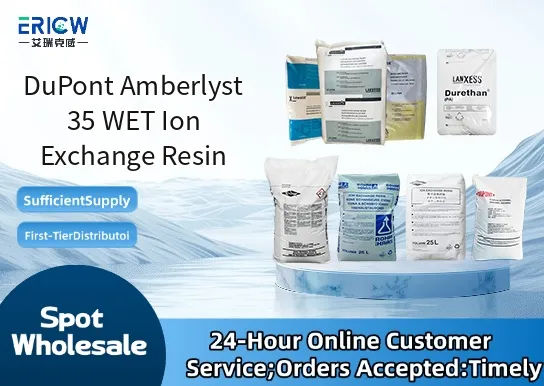
Highly crosslinked macroreticular sulfonic acid-based cation exchange resin in fully hydrated (wet) form for immediate use.
Superior thermal stability up to 130 °C, enabling robust performance in elevated-temperature reaction systems.
Enhanced mechanical strength and abrasion resistance due to optimized polymer matrix structure.
Consistent particle size distribution with high uniformity coefficient, ensuring low pressure drop and uniform flow dynamics.
Low soluble organic extractables, supporting compliance with stringent purity requirements in pharmaceutical and fine chemical synthesis.
Esterification and transesterification reactions, including biodiesel production (FAME synthesis).
Hydration of olefins to produce industrial alcohols such as tert-butanol and isopropanol.
Hydrolysis of acetals, ketals, and nitriles in fine chemical and active pharmaceutical ingredient (API) manufacturing.
Alkylation and condensation reactions requiring strong Brønsted acidity under mild conditions.
Removal of trace metal cations and acidic impurities from process streams in specialty chemical purification.
| Chemical Type | Sulfonated styrene-divinylbenzene copolymer (strongly acidic cation exchange resin) |
| Product Form | Wet, ready-to-use spherical beads |
| Appearance | Amber-colored, translucent gel-type beads with slight surface moisture |
| Functional Group | Sulfonic acid (–SO₃H) |
| Ion Form | H⁺ (hydrogen form) |
| Moisture Content | 45–50% (as supplied) |
| Particle Size Range | 300–1200 µm |
| Uniformity Coefficient | ≤1.8 |
Q1: What is the physical form and handling advantage of Amberlyst 35 WET compared to dry resin forms?
A: Amberlyst 35 WET is supplied pre-hydrated in water, eliminating the need for time-consuming and potentially exothermic wetting steps during commissioning. This reduces startup risk, minimizes operator exposure to dust, and ensures immediate readiness for use in aqueous reaction or purification systems.
Q2: Is Amberlyst 35 WET suitable for continuous-flow fixed-bed applications?
A: Yes — its high mechanical strength, uniform spherical morphology, and low pressure drop characteristics make it well-suited for continuous fixed-bed operation in esterification, hydrolysis, and transesterification processes, especially under moderate temperature and flow conditions.
Q3: How does Amberlyst 35 WET compare to Amberlyst 15 in terms of thermal stability and catalytic activity?
A: Amberlyst 35 WET features a macroporous matrix with enhanced thermal stability, allowing reliable performance at temperatures up to approximately 130 °C. It offers higher acid capacity and improved resistance to fouling in polar media compared to gel-type resins like Amberlyst 15, particularly in reactions involving water or alcohols.
Q4: Can Amberlyst 35 WET be regenerated after deactivation, and what are common causes of performance loss?
A: Regeneration is possible in many cases — typical approaches include washing with dilute acid or solvent followed by water rinsing — but effectiveness depends on the nature of deactivation. Common causes include irreversible fouling by high-molecular-weight species, metal ion poisoning, or prolonged exposure to oxidizing agents or extreme pH.
Contact With Us:
E-mail: wangxingqiang@ericwchem.com
Have a Questions? Call Us:
Add:
Building A1, Jiete Industrial Park, Huangpu District, Guangzhou City, Guangdong Province, China