English
 Español
 tiếng việt
 русский
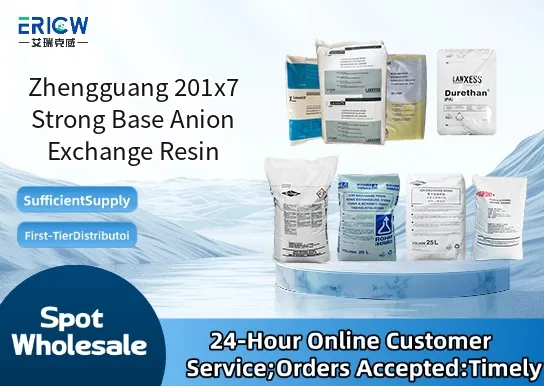
Highly cross-linked polystyrene matrix with quaternary ammonium functional groups for superior chemical stability.
Excellent selectivity and capacity for chloride, sulfate, nitrate, and other common anions in aqueous solutions.
Consistent particle size distribution ensures low pressure drop and uniform hydraulic performance in column operation.
Resistant to osmotic shock and mechanical attrition under repeated regeneration cycles.
Compliant with FDA 21 CFR §173.25 and meets ISO 9001 manufacturing standards.
Deminalization and polishing of boiler feedwater in power generation plants.
Nitrate and sulfate removal from municipal and industrial drinking water supplies.
Electroplating rinse water recovery and heavy metal anion complex separation.
Purification of pharmaceutical process water and excipient-grade water preparation.
Pre-treatment for reverse osmosis (RO) systems to reduce fouling and extend membrane life.
| Chemical Type | Strong base anion exchange resin (Type I quaternary ammonium) |
| Product Form | Moist, spherical beads |
| Appearance | Off-white to light yellow, translucent beads |
| Functional Group | –N(CH₃)₃Cl⁻ |
| Ion Form | Chloride form (Cl⁻) |
| Moisture Content | 48–55% (w/w) |
| Uniformity Coefficient | ≤1.6 |
| Maximum Operating Temperature | 60 °C |
Q1: What is the primary functional group and matrix structure of Zhengguang 201x7?
A: Zhengguang 201x7 features a styrene-divinylbenzene (S-DVB) macroporous matrix with quaternary ammonium groups (–N⁺(CH₃)₃) as the active strong base anion exchange sites, providing high selectivity for multivalent anions and stable performance across a broad pH range.
Q2: In which water treatment applications is this resin most commonly deployed?
A: It is widely used in demineralization systems, nitrate/nitrite removal from potable water, sulfate control in industrial process water, and polishing stages of ultrapure water production—particularly where high total exchange capacity and resistance to organic fouling are required.
Q3: How does Zhengguang 201x7 compare to gel-type strong base anion resins in terms of operating performance?
A: As a macroporous resin, 201x7 offers superior kinetic performance and greater tolerance to suspended solids and organic contaminants compared to conventional gel-type analogues. It maintains effective ion exchange capacity under variable flow rates and temperature conditions, and shows enhanced regeneration efficiency with sodium chloride or caustic soda.
Q4: What pretreatment is recommended before initial use?
A: Prior to service, the resin should undergo thorough backwashing to remove fines, followed by full regeneration using a concentrated sodium chloride solution. A final rinse with deionized water to near-neutral effluent pH is advised to ensure optimal startup performance and minimize leaching of residual regenerant.
Contact With Us:
E-mail: wangxingqiang@ericwchem.com
Have a Questions? Call Us:
Add:
Building A1, Jiete Industrial Park, Huangpu District, Guangzhou City, Guangdong Province, China