English
 Español
 tiếng việt
 русский
High thermal stability suitable for processing temperatures up to 1200 °C.
Excellent chemical resistance to acids, alkalis, and solvents in demanding industrial environments.
Consistent particle size distribution ensuring uniform dispersion and color development.
Non-toxic, heavy-metal-free formulation compliant with global regulatory requirements including RoHS and REACH.
Outstanding lightfastness and weather resistance for long-term outdoor performance.
Ceramic glazes and underglaze decorations for tableware and sanitaryware.
Colorants in architectural and technical ceramics, including tiles and refractory products.
Pigmentation of vitreous enamels for metal substrates such as appliances and cookware.
Functional coloring agent in high-performance glass frits and low-expansion glass composites.
Stable pigment phase in advanced ceramic matrix composites (CMCs) for aerospace and energy applications.
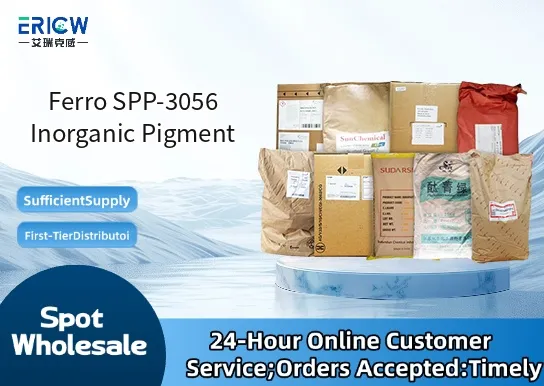
| Chemical Type | Mixed-Metal Oxide (Spinel-based) |
| Product Form | Fine, free-flowing powder |
| Appearance | Dark bluish-black granular powder |
| Primary Applications | Ceramics, vitreous enamels, glass frits |
| Key Features | Thermal stability, chemical inertness, non-volatility |
| Benefits | Color consistency across firing cycles, minimal batch variation |
| Storage Conditions | Keep in dry, cool, well-ventilated area; avoid moisture absorption |
| Shelf Life | 36 months from date of manufacture when stored properly |
Q1: What is the primary chemical composition of Ferro SPP-3056?
A: Ferro SPP-3056 is a high-performance inorganic pigment based on a complex metal oxide system, engineered for thermal and chemical stability. Its exact proprietary formulation is confidential, but it contains no heavy metals of concern such as lead, cadmium, or mercury, and complies with global regulatory expectations for general-purpose industrial pigments.
Q2: Is SPP-3056 suitable for use in food-contact plastics?
A: SPP-3056 is not pre-approved for direct food-contact applications under major food safety frameworks. It may be considered for indirect contact or non-migrating systems where full regulatory evaluation by the end-user is performed—however, formal food-grade compliance requires case-specific testing and documentation by the compounder or converter.
Q3: How does SPP-3056 perform under high-temperature processing conditions?
A: This pigment demonstrates excellent thermal stability and retains its color integrity during standard polymer processing—including injection molding, extrusion, and blow molding—at temperatures up to approximately 300 °C. It shows minimal degradation or gas evolution, making it well-suited for engineering thermoplastics and high-melt-index formulations.
Q4: What types of polymers is SPP-3056 commonly used with?
A: SPP-3056 is widely compatible with polyolefins (PP, HDPE, LDPE), engineering resins (PA6, PA66, PBT), and thermoplastic elastomers. It disperses effectively in both melt and masterbatch processes, though optimal results depend on proper carrier resin selection and dispersion aid integration.
Q5: What is the typical dosage range for achieving full opacity and consistent coloration?
A: Dosage depends on substrate, desired shade depth, and processing method—but SPP-3056 is generally effective at low concentrations, typically ranging from 0.1% to 2% by weight in final compounds. Higher loadings may be used for deep tones or demanding opacity requirements, without significant impact on mechanical properties when properly dispersed.
Contact With Us:
E-mail: wangxingqiang@ericwchem.com
Have a Questions? Call Us:
Add:
Building A1, Jiete Industrial Park, Huangpu District, Guangzhou City, Guangdong Province, China